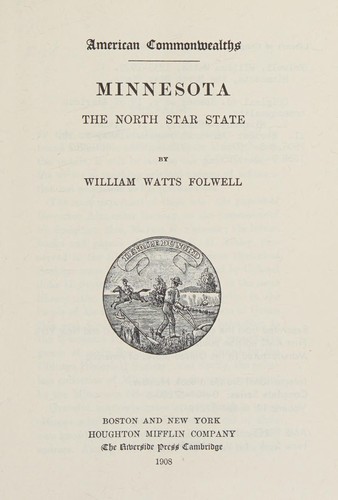
Minnesota, the North Star StateFolwell, William Watts
History
Minnesota, the North Star State
Folwell, William Watts
Minnesota -- History
A detachment of the Fourteenth Minnesota saw some service, happily
bloodless, in its own state. The Pillager band of Chippeway Indians on
Leech Lake had long been complaining of injustice done them in the
matter of the pine on their reservation, which they had been persuaded
to sell. The prices paid them were ridiculously low, and the charges
for appraisal and inspection as ridiculously high. Parties holding
permits to cut “dead and down timber,” cut live trees standing
convenient. Repeated protests to the government had brought no redress.
The deputy United States marshal, Sheehan (he of Fort Ridgely),
undertook to arrest a chief who had given show of misbehavior. He
resisted arrest, and a number of his braves rallied and stood off the
marshal’s posse. A company of sixty United States infantry was sent
from Fort Snelling, which was later reinforced by two hundred men
commanded by Major M. C. Wilkinson and supervised by General Bacon. On
October 5 the troops were landed on the peninsula known as Sugar Point,
and a sharp little conflict followed which cost the lives of Major
Wilkinson, Sergeant William Butler, and two privates. Two companies of
the Fourteenth were recalled from furlough and distributed to stations
of the railroad running north of Leech Lake. After repeated councils,
at which the United States commissioner of Indian affairs was present,
eight chiefs surrendered to the marshal, and the war ended. Governor
Clough, in his message to the legislature of 1899, charged the United
States government with a “series of acts and neglects most wrongful to
the Indians” and with a “blunder more criminal in its results than
those neglects and acts,” the performance being the “climax of a long
course of folly and wrong.”
* * * * *
All branches of the public school system have been enlarged and
improved. The common school endowment from the lands granted by
Congress has increased to more than $11,000,000. Sales of pine timber
($3,500,000) and other items have swelled the fund to more than
$20,000,000. The state still holds millions of acres unsold. The
excellent work of the normal schools, supplemented by that of the high
schools, has greatly added to the number of qualified teachers.
Opposition to the normal schools, now five in number, has long since
ceased.
Public-domain text, read in full here on John Shaqi.
Reviews
Reviews
No reviews yet
Be the first to share your thoughts on this work.
Elsewhere in the archive
Join the Discussion
Join the discussion
Sign in to leave a comment or review.
Sign InorCreate an account