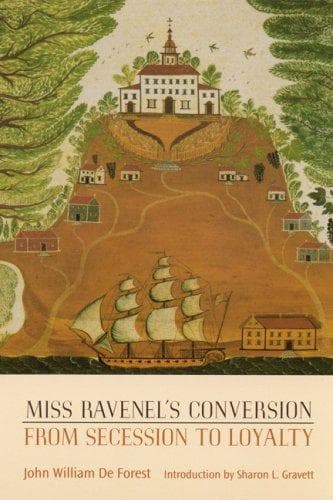
Miss Ravenel's conversion from secession to loyaltyDe Forest, John William
History
Miss Ravenel's conversion from secession to loyalty
De Forest, John William
Historical fiction; United States -- History -- Civil War, 1861-1865 -- Fiction; War stories; Women -- United States -- Fiction
"I don't think that I saw a single old acquaintance," said the Doctor,
rubbing his head thoughtfully. "It is astonishing how the high and
mighty ones have disappeared from this city, where they used to suppose
that they defied the civilized world. The barbarians didn't know what
the civilized world could do to them. The conceited braggadocia of New
Orleans a year ago is a most comical reminiscence now, in the midst of
its speechless terror and submission. One can't help thinking of frogs
sitting around their own puddle and trying to fill the universe with
their roarings. Some urchin throws a stone into the puddle. You see
fifty pairs of legs twinkle in the air, and the uproar is followed by
silence. It was just so here. The United States pitched Farragut and
Butler into the puddle of secession, and all our political roarers dived
out of sight. Many of them are still here, but they keep their noses
under water. By the way, I did see two of my old students, Bradley and
John Akers. Bradley told me that the rebel authorities maintained a
pretence of victory until the last moment, probably in order to keep the
populace quiet while they got themselves and their property out of the
city. He was actually reading an official bulletin stating that the
Yankee fleet had been sunk in passing the forts when he heard the bang,
bang, bang of Farragut's cannonade at Chalmette. Akers was himself at
Chalmette. He says that the Hartford came slowly around the bend below
the fort with a most provoking composure. They immediately opened on her
with all their artillery. She made no reply and began to turn. They
thought she was about to run away, and hurrahed lustily. Suddenly,
whang! crash! she sent her whole broadside into them. Akers says that
not a man of them waited for a second salute; they started for the woods
in a body at full speed; he never saw such running. Their heels twinkled
like the heels of the frog that I spoke of."
"But they made a good fight at the forts, papa."
"My dear, the devil makes a good fight against his Maker. But it small
credit to him--it only proves his amazing stupidity."
"Papa," said Lillie after a few minutes of silence, "I think you might
let those stones alone and take me out to walk."
"To-morrow, my child. It is nearly sunset now, and Mr. Colburne may come
early."
A quarter of an hour later he laid aside his minerals and picked up his
hat.
"Where are you going?" demanded Lillie eagerly and almost pettishly. It
was a question that she never failed to put to him in that same
semi-aggrieved tone every time that he essayed to leave her. She did not
want him to go out unless she went in his company. If he would go, it
was, "When will you come back?" and when he returned it was, "Where have
you been?" and "Who did you see?" and "What did he say?" &c. &c. Never
was a child so haunted by a pet sheep, or a handsome husband by a plain
wife, as was this charming papa by his doating daughter.
Public-domain text, read in full here on John Shaqi.
Reviews
Reviews
No reviews yet
Be the first to share your thoughts on this work.
Elsewhere in the archive
Join the Discussion
Join the discussion
Sign in to leave a comment or review.
Sign InorCreate an account