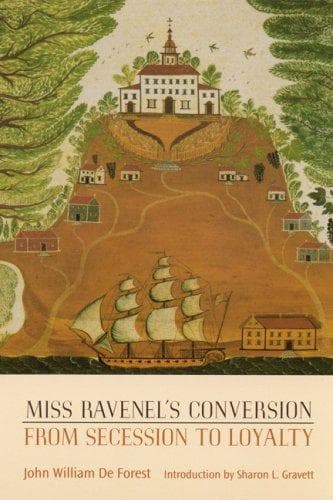
Miss Ravenel's conversion from secession to loyaltyDe Forest, John William
History
Miss Ravenel's conversion from secession to loyalty
De Forest, John William
Historical fiction; United States -- History -- Civil War, 1861-1865 -- Fiction; War stories; Women -- United States -- Fiction
Of course it would be agreeable to have a scene here between Colburne
and Miss Ravenel; some burning words to tell, some thrilling looks to
describe, such as might show how they stood with regard to each
other--something which would visibly advance both these young persons'
heart-histories. But they behaved in a disappointingly well-bred manner,
and entirely refrained from turning their feelings wrong side outwards.
With the exception of Miss Ravenel's inveterate blush and of a slightly
unnatural rapidity of utterance in Captain Colburne, they met like a
young lady and gentleman who were on excellent terms, and had not seen
each other for a month or two. This is not the way that heroes and
heroines meet on the boards or in some romances; but in actual human
society they frequently balk our expectations in just this manner.
Melo-dramatically considered real life is frequently a failure.
"You don't know how pleasant it is to me to meet you and your father,"
said Colburne. "It seems like New Boston over again."
The time during which he had known the Ravenels at New Boston was now a
pasture of very delightful things to his memory.
"It is pleasant to me because it seems like New Orleans," laughed Miss
Lillie. "No, not much like New Orleans, either," she added. "It used to
be so gay and amusing! You have made an awfully sad place of it with
your patriotic invasion."
"It is bad to take medicine," he replied. "But it is better to take it
than to stay sick. If you will have the self-denial to live ten years
longer, you will see New Orleans more prosperous and lively than ever."
"I shan't like it so well. We shall be nobodies. Our old friends will be
driven out, and there will be a new set who won't know us."
"That depends on yourselves. They will be glad to know you, if you will
let them. I understand that the Napoleonic aristocracy courts the old
out-of-place oligarchy of the Faubourg St. Germain. It will be like that
here, I presume."
Mrs. Larue had at first remained silent, playing off a pretty little
game of shyness; but seeing that the young people had nothing special to
say to each other, she gave way to her sociable instincts and joined in
the conversation.
"Captain Colburne, I will promise to live the ten years," she said. "I
want to see New Orleans a metropolis. We have failed. You shall succeed;
and I will admire your success."
The patriotic young soldier looked frankly gratified. He concluded that
the lady was one of the far-famed Unionists of the South, a race then
really about as extinct as the dodo, but devoutly believed in by the
sanguine masses of the North, and of which our officers at New Orleans
were consequently much in search. He began to talk gaily, pushing his
hair up as usual when in good spirits, and laughing heartily at the
slightest approach to wit, whether made by himself or another. Some
people thought that Mr. Colburne laughed too much for thorough good
breeding.
Public-domain text, read in full here on John Shaqi.
Reviews
Reviews
No reviews yet
Be the first to share your thoughts on this work.
Elsewhere in the archive
Join the Discussion
Join the discussion
Sign in to leave a comment or review.
Sign InorCreate an account