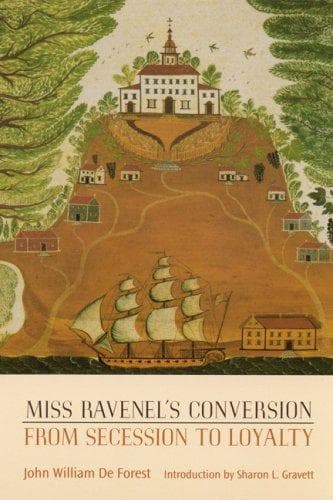
Miss Ravenel's conversion from secession to loyaltyDe Forest, John William
History
Miss Ravenel's conversion from secession to loyalty
De Forest, John William
Historical fiction; United States -- History -- Civil War, 1861-1865 -- Fiction; War stories; Women -- United States -- Fiction
"You will have nothing to do with the regiment," he went on. "As soon as
it is organized, or under way, you will be detached. You will be
superintendent of negro education, or superintendent of negro labor, or
something of that sort. You will have the rank and pay of Colonel, you
see; but your work will be civil instead of military; it will be for the
benefit of the niggers."
"Oh, indeed!" answered the Doctor, his face for the first time showing
that the proposition had for him a pole of attraction. "So officers can
be detached for such purposes? It is perfectly honorable, is it?"
"Quite so. Army custom. About the same thing as making an officer a
provost-marshal, or military governor, or mayor."
"Really, I am vastly tempted. I am vastly flattered and very grateful. I
must think of it. I will consider it seriously."
In his philanthropic excitement he rose and walked the room for some
minutes. The windows were open and admitted what little noise of
population there was in the street, so that Miss Ravenel and the
Colonel, sitting near each other, could exchange a few words without
being overheard by the abstracted Doctor. I suspect that the young lady
was more angry at this moment than on any previous occasion recorded in
the present history. Colburne would have quailed before her evident
excitement, but Colonel Carter, the widower, faced her with a smile of
good-natured amusement. Seeing that there was no prospect of striking a
panic into the foe, she made a flanking movement instead of a direct
attack.
"What do you suppose the old army will think of the negro regiment
plan?"
"_Vin ordinaire_, I suppose."
"Then how can you advise my father to go into a thing which you call
_vin ordinaire_?" she demanded, her lips trembling with an agitation
which was partly anger, and partly alarm at her own audacity.
As this was a question which Carter could not answer satisfactorily
without telling her that he knew how poor her father was, and also knew
what a bad thing poverty was, he made no reply, but rose and sauntered
about the room with his thumbs in his vest pockets. And Lillie was so
curiously in awe of this mature man, who said what he pleased and was
silent when he pleased, that she made no further assault on him.
Public-domain text, read in full here on John Shaqi.
Reviews
Reviews
No reviews yet
Be the first to share your thoughts on this work.
Elsewhere in the archive
Join the Discussion
Join the discussion
Sign in to leave a comment or review.
Sign InorCreate an account