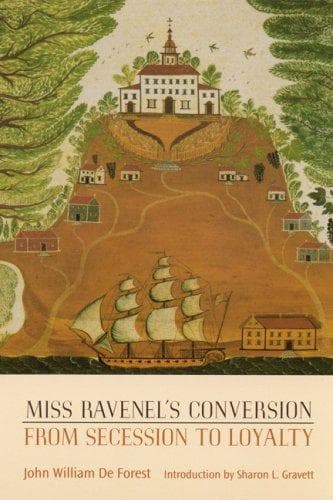
Miss Ravenel's conversion from secession to loyaltyDe Forest, John William
History
Miss Ravenel's conversion from secession to loyalty
De Forest, John William
Historical fiction; United States -- History -- Civil War, 1861-1865 -- Fiction; War stories; Women -- United States -- Fiction
"He hasn't starved long enough to bring him to his milk," he thought.
"When he gets down to his last dollar, and a thousand or two below it,
he won't be so particular as to how he lines his pockets."
The Colonel almost felt that a civilian had no right to such a delicate
and costly sense of honor. He would have been rather glad to have the
Doctor enter into some of these schemes for getting money, inasmuch as
this same filthy lucre was all that Miss Ravenel needed to make her a
very attractive _partie_. The next day he repaired at the earliest
office hours to head-quarters, and plead earnestly to have the proposed
superintendency founded on the basis of a civil office, the salary to be
furnished by the State, or by the city, or by a per-centage levied on
the wages of the negroes. But the Proconsul did not like to assume such
a responsibility, and moreover would not sympathise with the Doctor's
fastidiousness on the subject of the uniform. The Colonel hurried back
to Ravenel and urged him to accept the military appointment. He repeated
to him, "Remember, this is a matter of twenty-six hundred a year," with
a pertinacity which was the same as to say, "You know that you cannot
afford to refuse such a salary." The Doctor did not dispute the
correctness of the insinuation, but persisted with smiling obstinacy in
declining the eagles. I am inclined to think that he was somewhat
unreasonable on the subject, and that the Colonel was not far from right
in being secretly a little angry with him. The latter did not care a
straw for the niggers, but he desired very earnestly to put the Ravenels
on the road to fortune, and he foresaw that a superintendent of colored
labor would infallibly be tempted by very considerable side earnings and
perquisites. Even Miss Lillie was rather disappointed at the failure of
the project. To arm negroes, to command a colored regiment, was
abolitionistic and abominable; but to set the same negroes to work on a
hundred plantations, would be playing the southerner, the planter, the
sugar aristocrat, on a magnificent scale; and she thought also that in
this business her father might do ever so much good, and make for
himself a noble name in Louisiana, by restoring thousands of runaway
field-hands to their lawful owners. Let us not be too severe upon the
barbarian beliefs of this civilized young lady. She had not the same
geographical reasons for loving human liberty in the abstract that we
have who were nurtured in the truly free and democratic North. Moreover,
for some reason which I shall not trouble myself to discover, all women
love aristocracies.
The Ravenel funds were getting low, and the Doctor, despairing of
finding profitable occupation in depopulated New Orleans, was thinking
seriously of returning to New Boston, when High Authority sent him an
appointment as superintendent of a city hospital, with a salary of
fifteen hundred dollars.
Public-domain text, read in full here on John Shaqi.
Reviews
Reviews
No reviews yet
Be the first to share your thoughts on this work.
Elsewhere in the archive
Join the Discussion
Join the discussion
Sign in to leave a comment or review.
Sign InorCreate an account