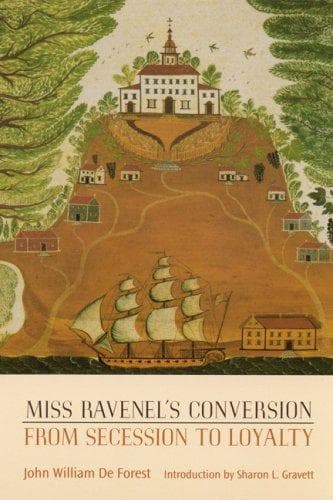
Miss Ravenel's conversion from secession to loyaltyDe Forest, John William
History
Miss Ravenel's conversion from secession to loyalty
De Forest, John William
Historical fiction; United States -- History -- Civil War, 1861-1865 -- Fiction; War stories; Women -- United States -- Fiction
In some Arabian Nights or other, there is a story of voyagers in a
becalmed ship who were drifted by irresistible currents towards an
unknown island. As they gazed at it their eyes were deceived by an
enchantment in the atmosphere, so that they seemed to see upon the shore
a number of beautiful women waiting to welcome them, whereas these
expectant figures were really nothing but hideous apes with carniverous
appetites, whose desire it was to devour the approaching strangers.
As Miss Ravenel drifted towards Colonel Carter she beheld him in the
guise of a pure and noble creature, while in truth he was a more than
commonly demoralized man, with potent capacities for injuring others.
Mrs. Larue, on the other hand, perceived him much as he was, and liked
him none the less for it. Had she lived in the days before the flood she
would not have cared specially for the angels who came down to enjoy
themselves with the daughters of men, except just so far as they
satisfied her vanity and curiosity. Seeing clearly that the Colonel was
not a seraph, but a creature of far lower grade, very coarse and carnal
in some at least of his dispositions, she would still have been pleased
to have him fall in love with her, and would perhaps have accepted him
as a husband. It is probable that she did not have a suspicion of the
glamour which humbugged the innocent eyes of her youthful cousin. But
she did presently perceive that it would be Lillie, and not herself, who
would receive Carter's offer of marriage, if it was ever made to
either. How should she behave under these trying circumstances? Painful
as the discovery may have been to her vanity, it had little effect on a
temper so callously amiable, and none on the lucid wisdom of a spirit so
clarified by selfishness. She showed that she was a person of good
worldly sense, and of little heart. She soon brought herself to
encourage the Carter flirtation, partly because she had a woman's
passion for seeing such things move on, and partly for reasons of state.
If the Colonel married Lillie he would be a valuable friend at court;
moreover the match could not hurt the social position of her relatives,
who were ostracised as Yankees already; it would be all gain and no
loss. She soon discovered, as she thought, that there was no need of
blowing the Colonel's trumpet in the ears of Miss Lillie, and that the
young lady could be easily brought to greet him with a betrothal hymn
of, "Hail to the chief who in triumph advances." But the Doctor, who
evidently did not like the Colonel, might exercise a deleterious
influence on these fine chances. Madame Larue must try to lead the silly
old gentleman to take a reasonable look at his own interests. What a
paroxysm of vexation and contempt she would have gone into, had she
known of his refusal to make forty or fifty thousand dollars on sugar,
merely because the transaction might furnish the Confederate army with
Public-domain text, read in full here on John Shaqi.
Reviews
Reviews
No reviews yet
Be the first to share your thoughts on this work.
Elsewhere in the archive
Join the Discussion
Join the discussion
Sign in to leave a comment or review.
Sign InorCreate an account