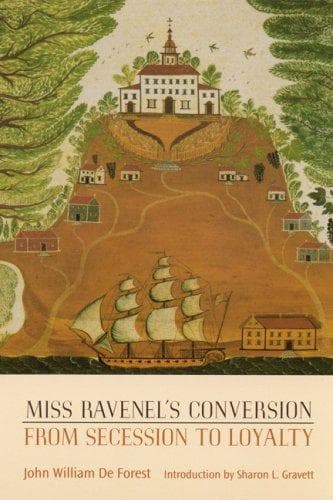
Miss Ravenel's conversion from secession to loyaltyDe Forest, John William
History
Miss Ravenel's conversion from secession to loyalty
De Forest, John William
Historical fiction; United States -- History -- Civil War, 1861-1865 -- Fiction; War stories; Women -- United States -- Fiction
"D----n it! of course I mean to fight," muttered the Colonel, when he
had finished his second reading. "I'll resign the mayoralty, and ask for
active service and a brigade. Then I must write something to explain
that filibustering business.--No, I won't. The less that is explained,
the better. I'll deny it outright.--Now there's Weitzel. He, by" (this
and that) "can have a star, and I can't. My junior, by" (that and the
other) "in the service, by" (this and that) "by at least six years. What
if he should get the active brigade? It would be just him, by" (this and
that) "to want it, and just like Butler, by" (that and the other) "to
give it to him."
The Colonel sat for a long time in vexatious thought, slapping his
mosquito bites, relighting his stump and smoking it down to its
bitterest dregs. Finally, without having written a word, he gave up the
battle with the stinging multitudes, drank a glass of brandy and water,
turned off the gas, stepped into the adjoining bedroom, kicked off his
trousers (long since unbuttoned), drew the mosquito-curtain, and went to
bed as quickly and quietly as an infant. Soldiering habits had enabled
him to court slumber with success under all circumstances.
During the month of September was formed that famous organization,
composed of five regiments of infantry, with four squadrons and two
batteries attached, known officially as the Reserve Brigade, but
popularly as Weitzel's. It was intended from the first for active
service, and the title Reserve was applied to it simply to mislead the
enemy. The regiments were encamped for purposes of drill and preparation
on the flats near Carrollton, a village four or five miles above New
Orleans. Carter applied for the brigade, but was unable to obtain it.
Weitzel was not only his superior in rank, but was Butler's favorite
officer and most trusted military adviser. Then Carter threw up his
mayoralty and reported for duty to his regiment, in great bitterness of
spirit at finding himself obliged to serve under a man who had once been
his junior and inferior. His only consolation was that this was not the
worst; both he and Weitzel were under the orders of an attorney.
Public-domain text, read in full here on John Shaqi.
Reviews
Reviews
No reviews yet
Be the first to share your thoughts on this work.
Elsewhere in the archive
Join the Discussion
Join the discussion
Sign in to leave a comment or review.
Sign InorCreate an account