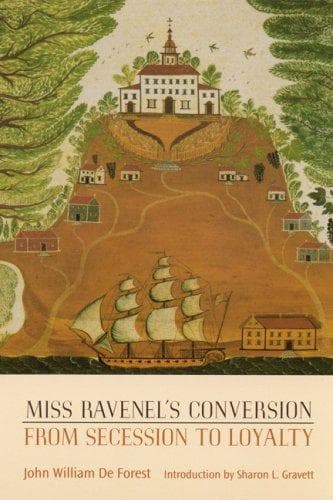
Miss Ravenel's conversion from secession to loyaltyDe Forest, John William
History
Miss Ravenel's conversion from secession to loyalty
De Forest, John William
Historical fiction; United States -- History -- Civil War, 1861-1865 -- Fiction; War stories; Women -- United States -- Fiction
Lillie did not think of asking if he had been civil to the Colonel; she
knew that he would not and could not be discourteous to any human
being. She made no answer to what he said except by going gently to him
and kissing him.
"Come, you must dress yourself," he added. "The regiment goes on board
the transport at twelve o'clock. I promised the Colonel that we would be
there to bid him--and Captain Colburne good-bye."
Dressing for the street was usually a long operation with Lillie, but
not this morning. Although she reached the station of the Carrollton
railroad in a breathless condition, it seemed to her that her father had
never walked so slowly; and on board the cars she really fatigued
herself with the nervous tension of an involuntary mental effort to push
forward the wheezy engine.
Carrollton is one the suburban offshoots of New Orleans, and contains
some two thousand inhabitants, mostly of the poorer classes, and of
Germanic lineage. Around it stretches the tame, rich, dead level which
constitutes southern Louisiana. The only raised ground is the levee; the
only grand feature of the landscape is the Mississippi; all the rest is
greenery, cypress groves, orange thickets, flowers, or bare flatness. As
Lillie emerged from the brick and plaster railroad-station she saw the
Tenth and its companion regiments along the levee, the men sitting down
in their ranks and waiting patiently, after the manner of soldiers. The
narrow open place between the river and the dusty little suburb was
thronged with citizens;--German shopkeepers, silversmiths, &c., who were
out of custom, and Irish laborers who were out of work;--poor women,
(whose husbands were in the rebel army) selling miserable cakes and beer
to the enlisted men; all, white as well as black, ragged, dirty,
lounging, listless hopeless; none of them hostile, at least not in
manner; a discouraged, subduced, stricken population. Against the bank
were moored six steamboats, their smoke-stacks, and even their upper
decks, overlooking the low landscape. They were not the famous floating
palaces of the Mississippi, those had all been carried away by Lovell,
or burnt at the wharves, or sunk in battle near the forts; these were
smaller craft, such as formerly brought cotton down the Red River, or
threaded the shallows between Lake Pontchartrain and Mobile. They looked
more fragile even than northern steamboats; their boilers and machinery
were unenclosed, visible, neglected, ugly; the superstructure was a
card-house of stanchions and clapboards.
Public-domain text, read in full here on John Shaqi.
Reviews
Reviews
No reviews yet
Be the first to share your thoughts on this work.
Elsewhere in the archive
Join the Discussion
Join the discussion
Sign in to leave a comment or review.
Sign InorCreate an account