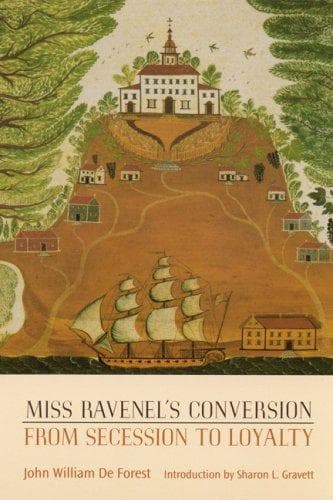
Miss Ravenel's conversion from secession to loyaltyDe Forest, John William
History
Miss Ravenel's conversion from secession to loyalty
De Forest, John William
Historical fiction; United States -- History -- Civil War, 1861-1865 -- Fiction; War stories; Women -- United States -- Fiction
Lillie was piqued at these praises of Colburne, not considering him half
so fine a character as Carter, in eulogy of whom her father said
nothing. She thought of asking him if he had noticed how the Captain
spoke of the Colonel as a hero--but concluded not to do it, for fear he
might reply that the latter ought to have paid the former the same
compliment. She felt that for the present, until her father's prejudices
should wear away, she must be contented with deifying her Achilles
alone. Notwithstanding this pettish annoyance, grievous as it was to a
most loving spirit strongly desirous of sympathy, the rest of the day
passed delightfully, the time being divided between frequent readings of
Carter's letter, and intervals of meditation thereon. The epistle which
her father wrote to the Colonel was also thoroughly read, and was in
fact so emendated and enlarged by her suggestions that it might be
considered her composition.
CHAPTER XVI.
COLONEL CARTER GAINS ONE VICTORY, AND MISS RAVENEL ANOTHER.
After the victory of Georgia Landing, the brigade was stationed for the
winter in the vicinity of the little half-Creole, half-American city of
Thibodeaux. I have not time to tell of the sacking of this land of rich
plantations; how the inhabitants, by flying before the northern Vandals,
induced the spoliation of their own property; how the negroes defiled
and plundered the forsaken houses, and how the soldiers thereby
justified themselves in plundering the negroes; how the furniture, plate
and libraries of the Lafourche planters were thus scattered upon the
winds of destruction. These things are matters of public and not of
private history. If I were writing the life and times of Colonel Carter,
or of Captain Colburne, I should relate them with conscientious
tediousness, adding a description in the best style of modern
word-painting of the winding and muddy Bayou Lafourche, the interminable
parallel levees, the flat border of rich bottom land, the fields of
moving cane, and the enclosing stretches of swampy forest. But I am
simply writing a biography of Miss Ravenel illustrated by sketches of
her three or four relatives and intimates.
To reward Colonel Carter for his gallantry at Georgia Landing, and to
compensate him for his disappointment in not obtaining the star of a
brigadier, the commanding general appointed him military governor of
Louisiana, and stationed him at New Orleans.
Public-domain text, read in full here on John Shaqi.
Reviews
Reviews
No reviews yet
Be the first to share your thoughts on this work.
Elsewhere in the archive
Join the Discussion
Join the discussion
Sign in to leave a comment or review.
Sign InorCreate an account