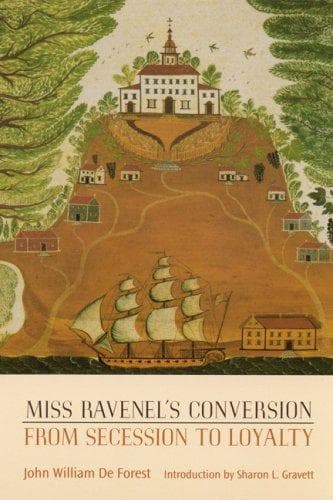
Miss Ravenel's conversion from secession to loyaltyDe Forest, John William
History
Miss Ravenel's conversion from secession to loyalty
De Forest, John William
Historical fiction; United States -- History -- Civil War, 1861-1865 -- Fiction; War stories; Women -- United States -- Fiction
And the Doctor had in reply looked a little indignant, not perceiving
the justice of the criticism. By the way, Lillie had a similar jealousy
of him, and was ready to slander any single woman who ogled him too
fondly. There were moments of great anguish when she feared that he
might be inveigled into admiring, perhaps loving, perhaps (horrid
thought!) marrying, Mrs. Larue. If it ever occurred to her that this
would be a poetically just retribution for her own sin of giving away
her heart without asking his approval, she drew no resignation from the
thought. I may as well state here that the widow did occasionally make
eyes at the Doctor. He was oldish, but he was very charming, and any man
is better than no man. She had given up Carter; our friend Colburne was
with his regiment at Thibodeaux; and the male angels of New Orleans were
so few that their visits were far between. So those half-shut, almond
eyes of dewy blackness and brightness were frequently turned sidelong
upon Ravenel, with a coquettish significance which made Lillie uneasy in
the innermost chambers of her filial affection. Mrs. Larue had very
remarkable eyes. They were the only features of her face that were not
under her control; they were so expressive that she never could fully
veil their meaning. They were beautiful spiders, weaving quite visibly
webs of entanglement, the threads of which were rays of dazzling light
and subtle sentiment.
"Devilish handsome eyes! Dangerous, by Jove!" remarked the Colonel,
judging in his usual confident, broadcast fashion, right rather more
than half the time. "I've seen the day, by Jove! when they would have
finished me."
For the present the Doctor was saved from their perilous witchery by the
advent of Colburne, who, having obtained a leave of absence for ten
days, came of course to spend it with the Ravenels. Immediately the
Larue orbs kindled for him, as if they were pyres whereon his passions,
if he chose, might consume themselves to ashes. She exhibited and felt
no animosity on account of bygones. She was a most forgiving,
cold-hearted, good-natured, selfish, well-bred little creature. She
never had standing quarrels, least of all with the other sex; and she
could practice a marvellous perseverance, without any acrimony in case
of disappointment. Colburne was favored with private interviews which he
did not seek, and visions of conquest which did not excite his ambition.
He was taken by gentle force up the intricate paths of a mountain of
talk, and shown the unsubstantial and turbulent kingdoms of coquetry,
with a hint that all might be his if he would but fall down and worship.
It became a question in his mind whether Milton should not have
represented Satan as a female of French extraction and New Orleans
education.
"Captain Colburne, you do not like women," she once said.
"I beg your pardon--I repel the horrible accusation."
Public-domain text, read in full here on John Shaqi.
Reviews
Reviews
No reviews yet
Be the first to share your thoughts on this work.
Elsewhere in the archive
Join the Discussion
Join the discussion
Sign in to leave a comment or review.
Sign InorCreate an account