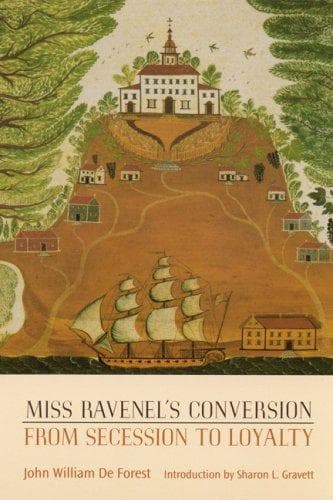
Miss Ravenel's conversion from secession to loyaltyDe Forest, John William
History
Miss Ravenel's conversion from secession to loyalty
De Forest, John William
Historical fiction; United States -- History -- Civil War, 1861-1865 -- Fiction; War stories; Women -- United States -- Fiction
But Mrs. Larue was not the only cause which prevented Colburne's visit
from being a monotony of happiness. He soon discovered that there was an
understanding between Colonel Carter and Miss Ravenel; not an
engagement, perhaps, but certainly an inner circle of confidences and
sentiments into which he was not allowed to enter. In this matter Lillie
was more open and legible than her lover. She so adored her hero because
of the deadly perils which he had affronted, and the honor which he had
borne from among their flame and smoke, that she could not always
conceal, and sometimes did not care to conceal, her admiration. Not
that she ever expressed it by endearments or fondling words: no, that
would have been a coarse audacity of which her maidenly nature was
incapable: but there were rare glances of irrepressible meaning,
surprised out of her very soul, which came like revelations. When she
asked Colburne to tell her the whole story of Georgia Landing, he
guessed easily what she most wanted to hear. To please her, he made
Carter the hero of the epic, related how impetuous he was during the
charge, how superbly cool as soon as it was over, how he sat his horse
and waved his sabre and gave his orders. To be sure, the enthusiastic
youth took a soldierly pleasure in the history; he was honestly proud of
his commander, and he loved to tell the tale of his own only battle. But
notwithstanding this slight pleasure, notwithstanding that the Doctor
treated him with even tender consideration, and that Mrs. Larue was
often amusing as well as embarrassing, he did not enjoy his visit. This
mysterious cloud which encompassed the Colonel and Miss Ravenel,
separating them from all others, cast upon him a shadow of melancholy.
In the first place, of course, it was painful to suspect that he had
lost this charming girl; in the second, he grieved on her account, not
believing it possible that with that man for a husband she could be
permanently happy. Carter was a brave soldier, an able officer, a person
of warm and naturally kind impulses; but gentlemen of such habits as his
were not considered good matches where Colburne had formed his opinions.
No man, whatever his talents, could win a professorship in Winslow
University, or occupy a respectable niche in New Boston society, who
rarely went to church, who drank freely and openly, who had been seen to
gamble, who swore like a trooper, and who did other things which the
Colonel had been known to do. All this time he was so over-modest by
nature, and so oppressed by an acquired sense of soldierly
subordination, that he never seriously thought of setting himself up as
a rival against the Colonel. Perhaps I am tedious in my analysis of the
Captain's opinions, motives and sentiments. The truth is that I take a
sympathetic interest in him, believing him to be a representative young
man of my native New England, and that I consider him a better match for
Public-domain text, read in full here on John Shaqi.
Reviews
Reviews
No reviews yet
Be the first to share your thoughts on this work.
Elsewhere in the archive
Join the Discussion
Join the discussion
Sign in to leave a comment or review.
Sign InorCreate an account