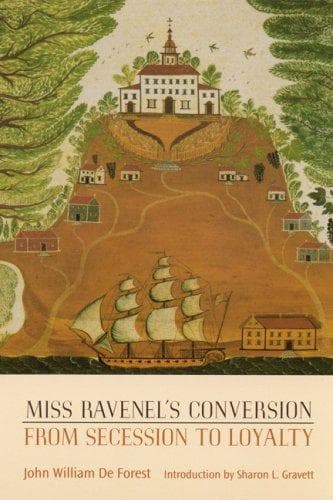
Miss Ravenel's conversion from secession to loyaltyDe Forest, John William
History
Miss Ravenel's conversion from secession to loyalty
De Forest, John William
Historical fiction; United States -- History -- Civil War, 1861-1865 -- Fiction; War stories; Women -- United States -- Fiction
There were no scenes during the leave of absence. Neither Colburne nor
Madame Larue made a declaration or received a refusal. Two days before
the leave of absence terminated he sadly and wisely and resolutely took
his departure for Thibodeaux. Nothing of interest happened to him during
the winter, except that he accompanied his regiment in Weitzel's advance
up the Teche, which resulted in the retreat of Mouton from Camp
Beasland, and the destruction of the rebel iron-clad "Cotton." A
narrative of the expedition, written with his usual martial enthusiasm,
but which unfortunately I have not space to publish, was received by
Doctor Ravenel, and declared by him to be equal in precision, brevity,
elegance, and every other classical quality of style, to the
Commentaries of Julius Cæsar. The Colonel remarked, in his practical
way, that the thing seemed to have been well planned, and that the
Captain's account was a good model for a despatch, only a little too
long-winded and poetical.
Colburne being absent, Mrs. Larue turned her guns once more upon the
Doctor. As the motto of an Irishman at a Donnybrook fair is, "Wherever
you see a head, hit it," so the rule which guided her in the Vanity Fair
of this life was, "Wherever you see a man, set your cap at him." It must
not be supposed, however, that she made the same eyes at the Doctor that
she made at Colburne. Her manner would vary amazingly, and frequently
did vary to suit her company, just as a chameleon's jacket is said to
change color according to the tree which he inhabits; and this was not
because she was simple and easily influenced, but precisely because she
was artful and anxious to govern, and knew that soft looks and words are
woman's best means of empire. It was interesting to see what a nun-like
and saintly _pose_ she could take in the presence of a clergyman. To the
Colonel she acted the part of Lady Gay Spanker; to the Doctor she was
_femme raisonnable_, and, so far as she could be, _femme savante_; to
Colburne she of late generally played the female Platonic philosopher.
It really annoys me to reflect how little space I must allow myself for
painting the character of this remarkable woman. "She was nobody's fool
but her own," remarked the Colonel, who understood her in a coarse,
incomplete way; nor did she deceive either Lillie or the Doctor in
regard to the main features of her character, although they had no
suspicion how far she could carry some of her secret caprices. It is
hard to blind completely the eyes of one's own family and daily
intimates.
Public-domain text, read in full here on John Shaqi.
Reviews
Reviews
No reviews yet
Be the first to share your thoughts on this work.
Elsewhere in the archive
Join the Discussion
Join the discussion
Sign in to leave a comment or review.
Sign InorCreate an account