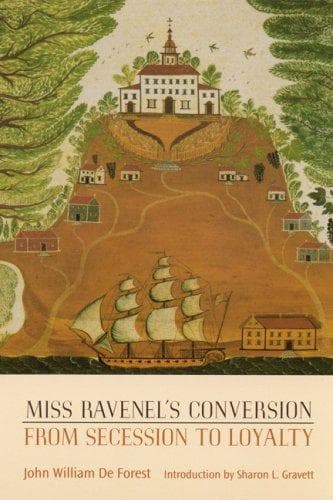
Miss Ravenel's conversion from secession to loyaltyDe Forest, John William
History
Miss Ravenel's conversion from secession to loyalty
De Forest, John William
Historical fiction; United States -- History -- Civil War, 1861-1865 -- Fiction; War stories; Women -- United States -- Fiction
"Oh, but--I don't anticipate an immediate close of the struggle. It may
last a year yet; and during that time--"
"That is not the point. King Stork has succeeded King Log. King Stork's
men must have the nice places and King Log's men must get out of them."
"Oh, but they won't turn you out," exclaimed Lillie, and then blushed as
she thought how her eagerness might be interpreted.
"We shall see," answered the Colonel gravely, and almost sadly. He was
so much in love with this girl that a life in Capua with her seemed
more desirable than the winning of Cannæ's away from her.
"Here is my fate," he said when he called on the following evening, and
handed her two official documents, the one relieving him from his
position as Military Governor, the other assigning him to the command of
a brigade.
"Now you must go into the battle again," she said, making a struggle to
preserve her self-possession.
"I am sorry,--on your account."
At this answer her effort at stoicism and maidenly dignity failed; she
dropped her head and hid her face in the sewing work on which she had
been engaged. This was too much for Carter, to whom love had been a
rejuvenation and almost a regeneration, so that he was as gentle,
virginal, and sensitive as if he had never known the hardening
experiences of a soldier and a man about town. Sitting down beside his
betrothed, he pressed her temples with both his hands and kissed the
light, flossy, amber-colored ripples of her hair. He could feel the
half-suppressed sobs which trembled through her frame, breaking softly
and noiselessly, like summer waves dying on a reedy shore. How he longed
to soothe her by grasping all her being into his and making her
altogether his own! He was on the point of falling before the temptation
which he had that morning resolved to resist. He knew that he ought not
to marry, with only his colonelcy as a support; yet he was about to urge
an immediate marriage, and would have done so had he spoken. Lillie
would not have refused him: it would not have been in the nature of
woman: what girl would put off a lover who was going to the
battle-field? Nothing prevented the consummation of this imprudence but
a ring at the door-bell. Miss Ravenel sprang up and fled from the
parlor, fearful of being caught with tears on her cheeks and her hair
disordered. Mrs. Larue entered, gave the Colonel a saucy courtesy, cast
a keen sidelong glance at his serious countenance, repressed apparently
some flippant remark which was on her lips, begged him to excuse her for
a few moments, and slid out of the room.
"Confound her!" muttered the Colonel, indignant at Madame without cause,
merely because he had been interrupted.
Public-domain text, read in full here on John Shaqi.
Reviews
Reviews
No reviews yet
Be the first to share your thoughts on this work.
Elsewhere in the archive
Join the Discussion
Join the discussion
Sign in to leave a comment or review.
Sign InorCreate an account