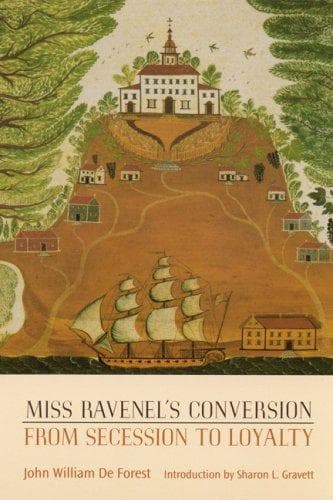
Miss Ravenel's conversion from secession to loyaltyDe Forest, John William
History
Miss Ravenel's conversion from secession to loyalty
De Forest, John William
Historical fiction; United States -- History -- Civil War, 1861-1865 -- Fiction; War stories; Women -- United States -- Fiction
I doubt whether the life in Ravenel's house contributed much to advance
his convalescence. His emotions were played upon too constantly and
powerfully for the highest good of the temporarily shattered instrument.
He had supposed that he would undergo one great shock on meeting Mrs.
Carter, and that then his trouble would be over. The first thrill was
not so potent as he expected; but it was succeeded by a constant unrest,
like the burning of a slow fever; he was uneasy all day and slept badly
at night. In the house he could not talk freely and gaily, because of
Lillie's presence; and out of it he could not feel with calmness,
because he was perpetually thinking of her. After all, it may have been
the splinters of bone in the arm, quite as much as the arrow in the
heart, which worried him. Of Mrs. Carter I must admit that she was not
merciful; she made the doubly-wounded Captain talk a great deal of his
Colonel. He might recite Carter's martial deeds and qualities as
lengthily as he pleased, and recommence _da capo_ to recite them over
again, not only without fatiguing her, but without exciting in her mind
a thought that he was doing any thing remarkable. She was very much
pleased, but she was not a bit grateful. Why should she be! It was
perfectly natural to her mind that people should admire the Colonel, and
talk much of his glory. Colburne performed this ill-paid task with
infinite patience, sympathy, and self-sacrificing love; and no warrior
was ever better sung in conversational epics than was Carter the
successful by Colburne the disappointed. Under the rude oppression of
this subject the bruised shrub exhaled daily sweetness. It is almost
painful to contemplate these two loving hearts: the one sending its
anxious sympathies a hundred miles away into the deadly trenches of
Port Hudson; the other pouring out its sympathies for a present object,
but covertly and without a thought of reward. If the passionate
affection of the woman is charming, the unrequited, unhoping love of the
man is sublime.
The Doctor perhaps saw what Lillie could not or would not see.
"My dear," he observed, "you must remember that Colonel Carter is not
the husband of Captain Colburne."
"Oh papa!" she answered. "Do you suppose that he doesn't like to talk
about Colonel Carter? Of course he does. He admires him, and likes him
immensely."
"I dare say--I dare say. But nevertheless you give him very large doses
of your husband."
"No, papa; not too large. He is such a good friend that I am sure he
doesn't object. Just think how unkind it would be not to want to talk
about my husband. You don't understand him if you think he is so
shabby."
Public-domain text, read in full here on John Shaqi.
Reviews
Reviews
No reviews yet
Be the first to share your thoughts on this work.
Elsewhere in the archive
Join the Discussion
Join the discussion
Sign in to leave a comment or review.
Sign InorCreate an account