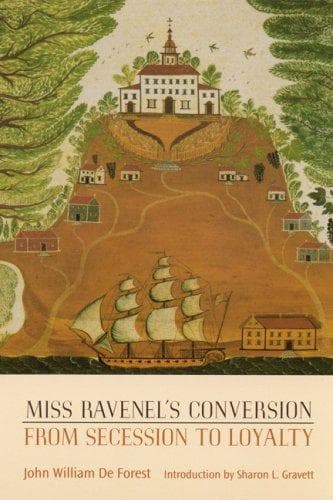
Miss Ravenel's conversion from secession to loyaltyDe Forest, John William
History
Miss Ravenel's conversion from secession to loyalty
De Forest, John William
Historical fiction; United States -- History -- Civil War, 1861-1865 -- Fiction; War stories; Women -- United States -- Fiction
Having got his arm bound anew with wet dressings, he sought out the
Quartermaster, and proceeded to accouter the Ravenel negroes, meanwhile
chewing a breakfast of hard crackers. Then, meeting the Lieutenant who
had directed him to Gazaway's quarters, and who proved to be the
commandant of the Louisiana company, they made a tour of the ramparts
together, doing their volunteer best to take in the military features of
the flat surrounding landscape, and to decide upon the line of approach
which the rebels would probably select in case of an assault. There was
no cover except two or three wooden houses of such slight texture that
they would afford no protection against shell or grape. The levee on the
opposite side of the bayou might shelter sharpshooters, but not a
column. They trained a twenty-four-pounder iron gun in that direction,
and pointed the rest of the artillery so as to sweep the plain between
the fort and a wood half a mile distant. The ditch was deep and wide,
and well filled with water, but there was no abattis or other
obstruction outside of it. The weakest front was toward the Mississippi,
on which side the rampart was a mere bank not five feet in height,
scarcely dominating the slope of twenty-five or thirty yards which
stretched between it and the water.
"I wish the river was higher--smack up to the fortifications," said the
Louisiana lieutenant. "They can wade around them fences," he added,
pointing to the palisades which connected the work with the river.
This officer was not a Louisianian by birth, any more than the men whom
he commanded. They were a medley of all nations, principally Irish and
Germans, and he had begun his martial career as a volunteer in an
Indiana regiment. He was chock full of fight and confidence; this was
the only fort he had ever garrisoned, and he considered it almost
impregnable; his single doubt was lest the assailants "might wade in
around them fences." Colburne, remembering how Banks had been repulsed
twice from inferior works at Port Hudson, also thought the chances good
for a defence. Indeed, he looked forward to the combat with something
like a vindictive satisfaction. Heretofore he had always attacked; and
he wanted to fight the rebels once from behind a rampart; he wanted to
teach them what it was to storm fortifications. If he had been better
educated in his profession he would have found the fort alarmingly small
and open, destitute as it was of bomb-proofs, casemates and traverses.
The river showed no promise of succor; not a gunboat or transport
appeared on its broad, slow, yellow current; not a friendly smoke could
be seen across the flat distances. The little garrison, it seemed, must
rely upon its own strength and courage. But, after taking a deliberate
view of all the circumstances, Colburne felt justified in reporting to
Major Gazaway that the fort could beat off as many Texans as could stand
between it and the woods, which was the same as to say a matter of one
Public-domain text, read in full here on John Shaqi.
Reviews
Reviews
No reviews yet
Be the first to share your thoughts on this work.
Elsewhere in the archive
Join the Discussion
Join the discussion
Sign in to leave a comment or review.
Sign InorCreate an account