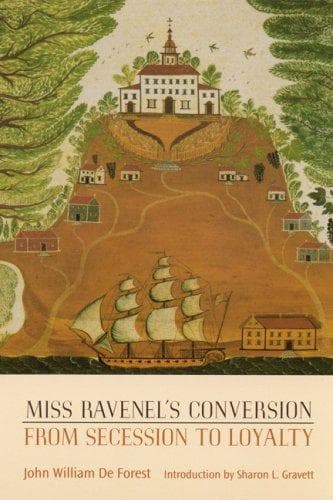
Miss Ravenel's conversion from secession to loyaltyDe Forest, John William
History
Miss Ravenel's conversion from secession to loyalty
De Forest, John William
Historical fiction; United States -- History -- Civil War, 1861-1865 -- Fiction; War stories; Women -- United States -- Fiction
As is usual with people in circumstances of romance which are not
instantly and overpoweringly alarming, there was an exhilaration in
their spirits which tended towards gayety. While Mrs. Carter and
Colburne were thus jesting, the Doctor shyly introduced his martial
equipments into the house, and concealed them under a blanket in one
corner. Presently the two men adjourned to the ramparts, to learn the
cause of a commotion which was visible among the garrison. Far up the
bayou road thin yellow clouds of dust could be seen rising above the
trees, no doubt indicating a movement of troops in considerable force.
From that quarter no advance of friends, but only of Texan cavalry and
Louisianian infantry, could be expected. Nearly all the soldiers had
left their shelters of boards and rubber blankets, and were watching the
threatening phenomenon with a grave fixedness of expression which showed
that they fully appreciated its deadly significance. Sand-columns of the
desert, water-spouts of the ocean, are a less impressive spectacle than
the approaching dust of a hostile army. The old and tried soldier knows
all that it means; he knows how tremendous will be the screech of the
shells and the ghastliness of the wounds; he faces it with an inward
shrinking, although with a calm determination to do his duty; his time
for elation will not come until his blood is heated by fighting, and he
joins in the yell of the charge. The recruit, deeply moved by the
novelty of the sight, and the unknown grandeur of horror or of glory
which it presages, is either vaguely terrified or full of excitement.
Calm as is the exterior of most men in view of approaching battle, not
one of them looks upon it with entire indifference. But let the eyes on
the fortifications strain as they might, no lines of troops could be
distinguished, and there was little, if any, increase in the number of
the rebel pickets who sat sentinel in their saddles under the shade of
scattered trees and houses. Presently the murmur "A flag of truce!" ran
along the line of spectators. Down the road which skirted the northern
bank of the bayou rode slowly, amidst a little cloud of dust, a party of
four horsemen, one of whom carried a white flag.
"What does that mean," asked Gazaway. "Do you think peace is
proclaimed?"
"It means that they want this fort," said Colburne. "They are going to
commit the impertinence of asking us to surrender."
The Major's aquiline visage was very pale, and his outstretched hand
shook visibly; he was evidently seized by the complaint which had so
troubled him at Port Hudson.
"Cap, what shall I do?" he inquired in a confidential whisper, twisting
one of his tremulous fingers into Colburne's buttonhole, and drawing him
aside.
Public-domain text, read in full here on John Shaqi.
Reviews
Reviews
No reviews yet
Be the first to share your thoughts on this work.
Elsewhere in the archive
Join the Discussion
Join the discussion
Sign in to leave a comment or review.
Sign InorCreate an account