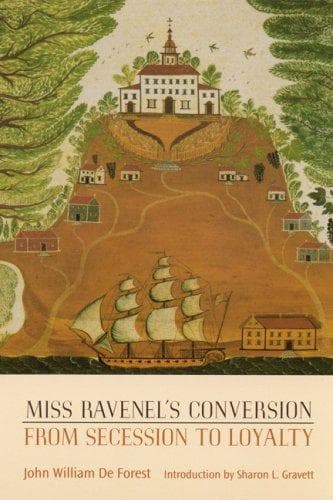
Miss Ravenel's conversion from secession to loyaltyDe Forest, John William
History
Miss Ravenel's conversion from secession to loyalty
De Forest, John William
Historical fiction; United States -- History -- Civil War, 1861-1865 -- Fiction; War stories; Women -- United States -- Fiction
A sergeant immediately shot him through the breast, and his body fell
inside of the works. Not a man of those whom he had appealed to followed
him; and only a few rose from their covers, to crouch again as soon as
they witnessed his fate. The fire of the garrison reopened with
violence, and soon there were new cries of, "We surrender," with a
waving of hats and handkerchiefs.
"What shall we do?" asked the Louisiana lieutenant. "They are three to
our one. If we let the d--n scoundrels in, they will knock us down and
take our guns away from us."
Colburne rose and called out, "Do you surrender?"
"Yes, yes," from many voices, and a frantic agitation of broadbrims.
"Then throw your arms into the river."
First one, then another, then several together obeyed this order, until
there was a general rush to the bank, and a prodigious splashing of
double-barreled guns and bowie-knives in the yellow water.
"Now sit down and keep quiet," was Colburne's next command.
They obeyed with the utmost composure. Some filled their pipes and fell
to smoking; others produced corn-cake from their havresacks and
breakfasted; others busied themselves with propping the wounded and
bringing them water. Quite a number crawled into the deserted shanties
and went to sleep, apparently worn out with the night's work and
watching. A low murmur of conversation, chiefly concerning the events of
the assault, and not specially gloomy in its tenor, gradually mingled
with the groans of the wounded. When the gate of the palisade was closed
upon them and refastened, they laughed a little at the idea of being
shut up in a pen like so many chickens.
"Trapped, by Jiminy!" said one. "You must excuse me if I don't know how
to behave myself. I never was cotched before. I'm a wild man of the
prairies, I am."
On all sides the attack had failed, with heavy loss to the assailants.
The heroic little garrison, scarcely one hundred and fifty strong,
including officers, camp-followers and negroes (all of whom had fought),
had captured more than its own numbers, and killed and wounded twice its
own numbers. The fragments of the repulsed brigades had fallen back
beyond the range of fire, and even the semicircle of pickets had almost
disappeared in the woods. The prisoners and wounded were taken on board
the gunboats, and forwarded to New Orleans by the first transport down
the river. As the last of the unfortunates left the shore Colburne
remarked, "I wonder if those poor fellows will ever get tired of
fighting for an institution which only prolongs their own inferiority."
Public-domain text, read in full here on John Shaqi.
Reviews
Reviews
No reviews yet
Be the first to share your thoughts on this work.
Elsewhere in the archive
Join the Discussion
Join the discussion
Sign in to leave a comment or review.
Sign InorCreate an account