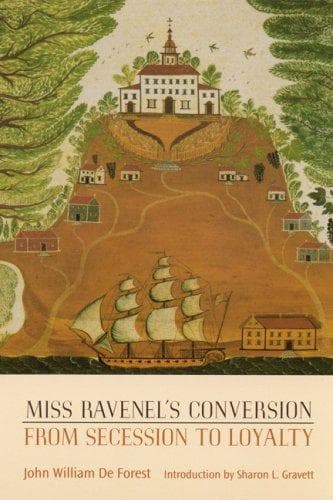
Miss Ravenel's conversion from secession to loyaltyDe Forest, John William
History
Miss Ravenel's conversion from secession to loyalty
De Forest, John William
Historical fiction; United States -- History -- Civil War, 1861-1865 -- Fiction; War stories; Women -- United States -- Fiction
It was so painful to see him struggle in that humiliating manner to
appear sober, that Colburne cut short the interview by pretexting a
necessity of reporting immediately to his regiment.
"Come to-morrow," said Carter. "All right to-morrow. Business to-morrow.
To-day--celebrash'n."
The Colonel, although not aware of the fact, was far advanced in the way
of the drunkard. He had long since passed the period when it was
necessary to stimulate his appetite for spirituous liquors by sugar,
lemon-peel, bitters and other condiments. He had lived through the era
of fancy drinks, and entered the cycle of confirmed plain whiskey. At
the New Orleans bars he did not call for the fascinating mixtures for
which those establishments are famous; he ran his mind's eye wearily
over the milk-punches, claret-punches, sherry-cobblers, apple-toddies,
tom-and-jerries, brandy-slings, and gin-cocktails; then said in a
slightly hoarse _basso profondo_, "Give me some plain whiskey." He had
swallowed a great deal of strong drink during the siege, and since the
surrender he had not known a sober waking moment. His appetite was poor,
especially at breakfast. His face was constantly flushed, his body had
an appearance of being bloated, and his hands were tremulous.
Nevertheless, obedient to a delusion common to men of his habits, he did
not consider himself a hard drinker. He acknowledged that he got
intoxicated at times and thoroughly, but he thought not more frequently
or thoroughly than the average of good fellows. He was kept in
countenance by a great host of comrade inebriates in the old service and
in the new, in the navy as well as in the army, in high civilian
position and at the front, in short throughout almost every grade and
class of American society. He could point to men whose talents and
public virtues the nation honors, and say, "They get as drunk as I do,
and as often." He could point to such cases on this side of the water
and on the other. Does anybody remember the orgies of the _viri clari et
venerabili_, who gathered at Boston to celebrate the obsequies of John
Quincy Adams, and at Charleston to lament over the remains of John C.
Calhoun? Does anybody remember the dinner speeches on board of Sir
Charles Napier's flagship, just before the Baltic fleet set out for
Cronstadt? Latterly this vice has increased upon us in America, thanks
to the reaction against the Maine liquor law, thanks to the war. Perhaps
it is for the best; perhaps it is a good thing that hundreds of leading
Americans and hundreds of thousands of led Americans should be
drunkards; it may be, in some incomprehensible manner, for the interest
of humanity. To my unenlightened mind the contrary seems probable; but I
am liable to error, and sober at this moment of writing: a pint of
whiskey might illuminate me to see behind the veil. It is wonderful to
me, a member of the guzzling Anglo-Saxon race, that the abstemious Latin
nations have not yet got the better of us.
Public-domain text, read in full here on John Shaqi.
Reviews
Reviews
No reviews yet
Be the first to share your thoughts on this work.
Elsewhere in the archive
Join the Discussion
Join the discussion
Sign in to leave a comment or review.
Sign InorCreate an account