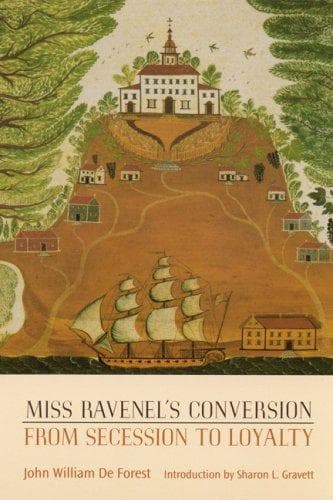
Miss Ravenel's conversion from secession to loyaltyDe Forest, John William
History
Miss Ravenel's conversion from secession to loyalty
De Forest, John William
Historical fiction; United States -- History -- Civil War, 1861-1865 -- Fiction; War stories; Women -- United States -- Fiction
Meanwhile how about Mrs. Larue? No one could have been more discreet,
more corruptly sagacious, more sunnily amiable, than this singular
woman. She petted Lillie like a child, helped her in her abundant sewing
labors, brought her as many bouquets as the Colonel himself, scolded
her for imprudencies, forbade this dish and recommended that, laughed at
her occasional despondencies, and cheered her as women know how to cheer
each other. She seemed like the truest friend of the young woman whom
she would not have hesitated much to rob of her husband, provided she
could have wished to do it. This kindness was not hypocrisy, but simple,
unforced good nature. It was natural, and therefore, agreeable to her to
be amiable; and as she always did what she liked to do, she was a
pattern of amiability. To have quarreled seriously with Lillie would
have been a downright annoyance to her, and consequently she avoided
every chance of a disagreement, so far at least as was consistent with
her private pleasures. She had not the slightest notion of eloping with
the Colonel; she did not take passions sufficiently _au grand sérieux_
for that; she would not have isolated herself from society for any man.
Notwithstanding Mrs. Larue's sugar mask Lillie was at times disposed to
fight her; not, however, in the slightest degree on account of her
husband; only on account of her father. The sly Creole, partly for her
own amusement indeed, but chiefly to divert suspicion from her
familiarity with Carter, commenced a coquettish attack upon the Doctor.
Lillie was sometimes in a desperate fright lest she should entrap him
into a marriage. She thought that she understood Mrs. Larue perfectly,
and she felt quite certain that she was by no means good enough for her
father. In her estimation there never was a man, unless it might be her
husband, who was so good, so noble, so charming as this parent of hers;
and if she had been called on to select a wife for him, I doubt whether
any woman could have passed the examination to which she would have
subjected the candidates.
"I perfectly spoil you, papa," she said, laughing. "I pet you and admire
you till I suppose I shall end by ruining you. If ever you go out into
the world alone, what will become of you? You will miss my care
dreadfully. You mustn't leave me; it's for your own good--hear? You
mustn't trust yourself to anybody else--hear?"
"I hear, my child," answers the Doctor. "What a charming little Gold
Coast accent you have!"
"Pshaw! It isn't negro at all. Everybody talks so. But I wonder if you
are trying to change the subject."
"Really I wasn't aware of a subject being presented for my
consideration."
"Oh, you don't understand, or you won't understand. I do believe you
have a guilty conscience."
"A guilty conscience about what, my child? Have the kindness to speak
plainly. My mind is getting feeble."
"Ain't you ashamed to ask me to speak plainly? I don't want to speak
plainly. Do you actually want to have me?"
Public-domain text, read in full here on John Shaqi.
Reviews
Reviews
No reviews yet
Be the first to share your thoughts on this work.
Elsewhere in the archive
Join the Discussion
Join the discussion
Sign in to leave a comment or review.
Sign InorCreate an account