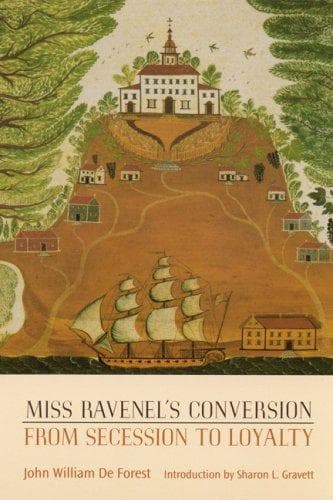
Miss Ravenel's conversion from secession to loyaltyDe Forest, John William
History
Miss Ravenel's conversion from secession to loyalty
De Forest, John William
Historical fiction; United States -- History -- Civil War, 1861-1865 -- Fiction; War stories; Women -- United States -- Fiction
The grandfather knew a great deal better than either the father or
mother how to handle the diminutive Jupiter. He took him from the
pillow, carried him to the window, drew the curtain slowly, and laughed
to see the solemn little eyes, after winking slowly, turn upward and fix
themselves steadily on the broad, mild effulgence of the sky.
"He looks for the light, as plants and trees lean towards it," said he.
"He is trying to see the heavenly mansions which he may some day
inhabit. Nobody knows how soon. They get up their chariots very suddenly
sometimes, these little Elijahs."
"Oh, don't talk so," implored Lillie. "He sha'n't die."
The Doctor was thinking of his own only boy, who had flown from the
cradle to Heaven more than twenty years ago.
Aside from tenderness for his wife, Carter's principal emotion all this
while was that of astonishment at his position. It cost him considerable
mental effort, and stretch of imagination, to conceive himself a
relative of the newcomer. He did not, like Lillie, love the child by
passionate instinct; and he had not yet learned to love him as he had
learned to love her. He was tender of the infant, as a creature whose
weakness pleaded for his protection; but when it came to the question of
affection, he had to confess that he loved him chiefly through his
mother. He was a poor hand at fondling the boy, being always afraid of
doing him some harm. He was better pleased to see him in Lillie's arms
than to feel him in his own; the little burden was curiously warm and
soft, but so evidently susceptible to injury as to be a terror.
"I would rather lead a storming party," he said. "I have been beaten in
that sort of thing, and lived through it. But if I should drop this
fellow--"
And here the warrior absolutely flinched at the thought of how he would
feel in such a horrible case.
Now commenced a beautiful reciprocal education of mother and child. Each
discovered every day new mysteries, new causes of admiration and love,
in the other. Long before a childless man or even woman would have
imagined signs of intelligence in the infant, the mother had not merely
imagined but had actually discovered them. You would have been wrong if
you had laughed incredulously when she said, "He begins to take notice."
Of course her fondness led her into errors: she mistook symptoms of mere
sensation for utterances of ideas; she perceived prophetically rather
than by actual observation: but some things, some opening buds of
intellect, she saw truly. She deceived herself when she thought that at
the age of three weeks he knew his father; but at the same time she was
quite correct in believing that he recognized and cried for his mother.
This delighted her; she would let him cry for a moment, merely for the
pleasure of being so desired; then she would fold him to her breast and
be his comforter, his life. They were teachers, consolers, deities, the
one to the other.
Public-domain text, read in full here on John Shaqi.
Reviews
Reviews
No reviews yet
Be the first to share your thoughts on this work.
Elsewhere in the archive
Join the Discussion
Join the discussion
Sign in to leave a comment or review.
Sign InorCreate an account