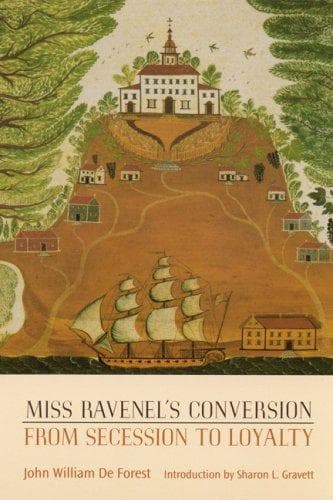
Miss Ravenel's conversion from secession to loyaltyDe Forest, John William
History
Miss Ravenel's conversion from secession to loyalty
De Forest, John William
Historical fiction; United States -- History -- Civil War, 1861-1865 -- Fiction; War stories; Women -- United States -- Fiction
Carter scowled and stopped smoking. He did not know what Walker could do
with him; he did not much believe that he legally could do anything; his
creditors never had done more than dun him. But High Authority might
perhaps be led to do unpleasant things: for instance, in the way of
relieving him from his position, if the fact should be forced upon its
notice, that so responsible an officer as the chief quartermaster of the
Gulf Department was burdened by private indebtedness. At all events it
was unpleasant to have a grasping, intriguing, audacious fellow like
Walker for a creditor to so large an amount. It would be a fine thing to
get out of debt once for all; to astonish his duns (impertinent fellows,
some of them) by settling every solitary bill with interest; to be rich
once for all, without danger of recurring poverty; to be rich enough to
force promotion. Other officials--quartermasters, paymasters, etc.--were
going in for cotton on the strength of Government deposits. The
influenza had caught the Colonel; indeed it was enough to corrupt any
man's honesty to breathe the moral atmosphere of New Orleans at that
time; it could taint the honor derived from blue ancestral blood and
West Point professional pride.
Carter did not, however, give way to his oily Mephistopheles during this
interview. Walker's victory was not so sudden as Mrs. Larue's; his
temptation was not so well suited as hers to the character of the
victim; the love of lucre could not compare as a force with _le divin
sens du génésiaque_. It was not until Walker had boldly threatened to
bring his claims before the General Commanding, not until the army had
well nigh reached the Red River, not until the chance of investment had
almost passed, that the Colonel became a speculator. Once resolved, he
acted with audacity, according to his temperament. But here,
unfortunately for the curious reader, we enter upon cavernous darkness,
where it is impossible to trace out a story except by hazardous
inference, our only guides being common rumor, a fragment of a letter, a
conversation half-overheard, and other circumstances of a like
unsatisfactory nature. Before giving my narrative publicity I feel bound
to state that the entire series of alleged events may be a fiction of
the excited popular imagination, founded on facts which might be
explained in accordance with an assumption of Carter's innocence, and
official honor.
Public-domain text, read in full here on John Shaqi.
Reviews
Reviews
No reviews yet
Be the first to share your thoughts on this work.
Elsewhere in the archive
Join the Discussion
Join the discussion
Sign in to leave a comment or review.
Sign InorCreate an account