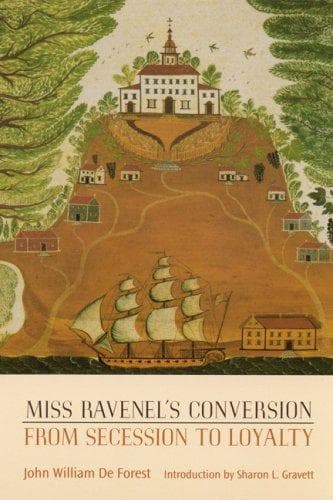
Miss Ravenel's conversion from secession to loyaltyDe Forest, John William
History
Miss Ravenel's conversion from secession to loyalty
De Forest, John William
Historical fiction; United States -- History -- Civil War, 1861-1865 -- Fiction; War stories; Women -- United States -- Fiction
The obese Walker was last seen by loyal eyes on the night which followed
the barren triumph of Pleasant Hill. He had had his horse shot under him
in the beginning of the fighting at Sabine Cross Roads, while in advance
of the column; had effected a masterly retreat, partly on foot and
partly on a Government mule which he took from a negro driver, who had
cut it loose from an entangled wagon; had fed himself abundantly from
the havresacks of defunct rebels on the field of victory; and then had
heroically set to work to make the best of circumstances. Believing
with the confidence of his sanguine nature that the army would advance
in the morning, he started on his mule, accompanied by two comrades of
the Ring, for the house of a neighboring planter, to whom it is supposed
that he had advanced cash for cotton. No one knows to this day what
became of him, or of his funds, or investments, or fellow adventurers.
All alike disappeared utterly and forever from the knowledge of the
Union army when the three rode into that night of blood and groans
beyond the flickering circle of light, thrown out by the camp fires.
The news of the calamity, we may suppose, nearly paralyzed Carter.
Defalcation, trial by court-martial, disgraceful dismissal from the
service, hard labor at Tortugas, ball and chain, a beggared family, a
crazed wife, must have made up a terrific spectre, advancing, close at
hand, unavoidable, pitiless. It would be a laborious task to analyze and
fully conceive the feelings of such a man in such a position. Naturally
and with inexorable logic followed the second act of the moral tragedy.
A deed which some men would call merely a blunder led straight to
another deed which all men would call a crime. He could not, as men have
sometimes done, hope to annul his indebtedness by the simple commission
of murder. Irresistible necessity drove him (if our hypothetical tale is
correct) into a species of wickedness which was probably more repugnant
to his peculiarly educated conscience than the taking of human life.
Public-domain text, read in full here on John Shaqi.
Reviews
Reviews
No reviews yet
Be the first to share your thoughts on this work.
Elsewhere in the archive
Join the Discussion
Join the discussion
Sign in to leave a comment or review.
Sign InorCreate an account