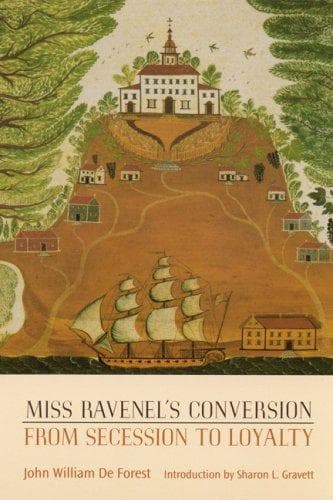
Miss Ravenel's conversion from secession to loyaltyDe Forest, John William
History
Miss Ravenel's conversion from secession to loyalty
De Forest, John William
Historical fiction; United States -- History -- Civil War, 1861-1865 -- Fiction; War stories; Women -- United States -- Fiction
"Let me see it," persisted Lillie, making a second and more successful
reach for the paper. She read the verses to herself with a slight flush
of excitement, and then quietly remarked that they were pretty. It has
been suspected that she kept that paper; at all events, when her father
sought it next morning to cut out the verses and paste them in his
common-place book, he could not find it; and while Lillie pretended to
take an interest in his search, she made no distinct answer to his
inquiries. I am told by persons wise in the ways of young ladies that
they sometimes lay aside trifles of this sort, and are afterwards
ashamed, from some inexplicable cause, of having the fact become patent
even to their nearest relatives. It must not be understood, by the way,
that Miss Ravenel had lost her slight admiration for that full-blown
specimen of the male sex, Colonel Carter. He was too much in the style
of a Louisiana planter not to be attractive to her homesick eyes. She
welcomed his rare visits with her invariable but nevertheless flattering
blush, and talked to him with a vivacity which sent flashes of pain into
the soul of Colburne. The young man admitted the fact of these spasms,
but tried to keep up a deception as to their cause. In his charity
towards himself he attributed them to an unselfish anxiety for the
happiness of that sweet girl, who, he feared, would find Carter an
unsuitable husband, however grandiose as a social ornament and
accomplished as an officer.
In spite of these sentimental possibilities of disagreement between the
Colonel and the Captain, their friendship daily grew stronger. The
former was not in the least influenced by lovelorn jealousy, and set
much store by Colburne as being the only officer in his regiment who was
precisely to his taste. He had desired, but had not been able to obtain,
the young gentlemen of New Boston, the sons of the college professors,
and of the city clergymen. The set was limited in number and not martial
nor enthusiastic in character. It had held aristocratically aloof from
the militia, from the fire companies, from personal interference in
local politics, from every social enterprise which could bring it into
contact with the laboring masses. It needed two years of tremendous war
to break through the shy reserve of this secluded and almost monastic
little circle, and let loose its sons upon the battlefield. The Colonel
was disgusted with his raft of tinkers and tailors, as he called his
officers, although they were mostly good drill-masters and creditably
zealous in learning the graver duties of their new profession. The
regular army, he said, had not been troubled with any such kind of
fellows. The brahminism of West Point and of the old service revolted
from such vulgar associations. It required the fiery breath of many
fierce battles, in which the gallantry of volunteers shone conspicuous,
to blow this feeling into oblivion.
Public-domain text, read in full here on John Shaqi.
Reviews
Reviews
No reviews yet
Be the first to share your thoughts on this work.
Join the Discussion
Join the discussion
Sign in to leave a comment or review.
Sign InorCreate an account