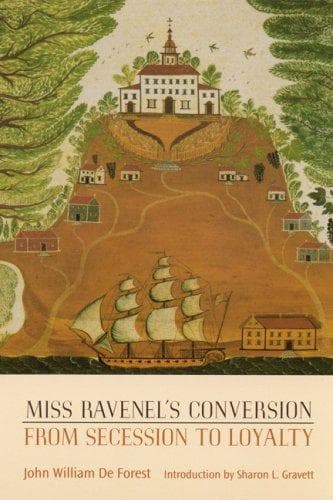
Miss Ravenel's conversion from secession to loyaltyDe Forest, John William
History
Miss Ravenel's conversion from secession to loyalty
De Forest, John William
Historical fiction; United States -- History -- Civil War, 1861-1865 -- Fiction; War stories; Women -- United States -- Fiction
One day the Colonel related in confidence to the Doctor a circumstance
which had given him peculiar disgust. The Governor having permitted him
to nominate his own Lieutenant-Colonel, he had selected an ex-officer of
a three months' regiment who had shown tactical knowledge, and
gallantry. The field position of Major he had finally resolved to demand
for Colburne. Hence an interview, and an unpleasant one, with the chief
magistrate of Barataria.
"Governor," said Carter, "I want that majority for a particular friend
of mine, the best officer in the regiment and the best man for the place
that I know in the State."
The Governor was in his little office reclining in a high-backed oaken
chair, and toasting his feet at a fire. He was a tall, thin, stooping
gentleman, slow in gait because feeble in health, with a benign dignity
of manner and an unvarying amiability of countenance. His eyes were a
pale blue, his hair a light chestnut slightly silvered by fifty years,
his complexion had once been freckled and was still fair, his smile was
frequent and conciliatory. Like President Lincoln he sprang from the
plain people, who were to conquer in this war, and like him he was
capable of intellectual and moral growth in proportion to enlargement of
his sphere of action. A modest, gentle-tempered, obliging man, patriotic
in every impulse, devout in the severe piety of New England,
distinguished for personal honor and private virtues, he was in the
main a credit to the State which had selected him for its loftiest
dignity.
He had risen from his chair and saluted the Colonel with marked respect.
Although he did not like his moral ways, he valued him highly for his
professional ability and courage, and was proud to have him in command
of a Baratarian regiment. To his shy spirit this aristocratic and
martial personage was in fact a rather imposing phenomenon. Carter had a
fearful eye; by turns audaciously haughty and insolently quizzical; and
on this occasion the Governor felt himself more than usually discomposed
under its wide open, steady, confident stare. He seemed even a little
tremulous as he took his seat; he dreaded to disagree with the
representative of West Point brahminism; and yet he knew that he must.
"Captain Colburne."
"Oh--Captain Colburne," hesitated the Governor. "I agree with you,
Colonel, in all that you say of him. I hope that there will be an
opportunity yet of pushing him forward. But just now," he continued with
a smile that was apologetical and almost penitent, "I don't see that I
can give him the majority. I have promised it to Captain Gazaway."
"To Gazaway!" exclaimed Carter. A long breath of angry astonishment
swelled his broad breast, and his cheek would have flushed if any
emotion could have deepened the tint of that dark red bronze.
"You don't mean, I hope, Governor, that you are resolved to give the
majority of my regiment to that boor."
Public-domain text, read in full here on John Shaqi.
Reviews
Reviews
No reviews yet
Be the first to share your thoughts on this work.
Join the Discussion
Join the discussion
Sign in to leave a comment or review.
Sign InorCreate an account