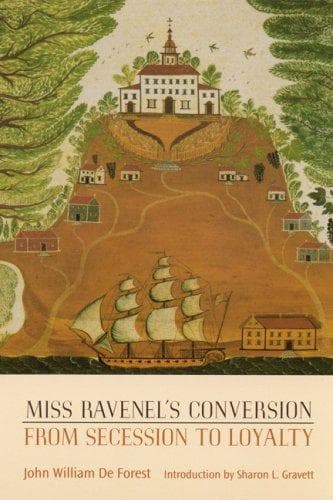
Miss Ravenel's conversion from secession to loyaltyDe Forest, John William
History
Miss Ravenel's conversion from secession to loyalty
De Forest, John William
Historical fiction; United States -- History -- Civil War, 1861-1865 -- Fiction; War stories; Women -- United States -- Fiction
In this new Capua, the only lap of luxury that our armies found during
the war, Carter, a curious compound of hardihood and sybaritism, forgot
that he wanted to be Hannibal, and that he had not yet fought his Cannæ.
He gave himself up to lazy pleasures, and even allowed his officers to
run to the same, in which they were not much discountenanced by the
commanding general, whose grim, practical humor was perhaps gratified by
the spectacle of freeborn mudsills dwelling in the palaces and emptying
the wine-cellars of a rebellious aristocracy. If, indeed, an undesirable
cub over-stepped some vague boundary, he found himself court-martialed
and dismissed the service. But the mass of the regimental officers,
being jealous in their light duties and not prominently obnoxious in
character, were permitted to live in such circumstances of comfort as
they chose to gather about them from the property of self-exiled
secessionists. Thus the regiment went through the season: no battles, no
marches, no privations, no exposures, no anxieties: not even any
weakening loss from the perilous climate. That terrible guardian angel
of the land, Yellow Jack, would not come to realize the fond
predictions of the inhabitants and abolish the alien garrison as a
similar seraph destroyed the host of Sennacherib.
"Don't you find it hot?" said a citizen to Captain Colburne. "You'll
find it too much for you yet."
"Pshaw!" answered the defiant youth. "I've seen it hotter than this in
Barataria with two feet of snow on the ground."
During the spring Colburne wrote several long letters to the Doctor,
with his mind, you may believe, fixed more on Miss Ravenel than on his
nominal correspondent. It was a case of moral strabismus, which like
many a physical squint, was not without its beauty, and was even quite
charming to the gaze of sentimental sympathy. It was a sly carom on the
father, with the intention of pocketing the daughter, but done with a
hand rendered so timorous by anxiety that the blows seemed to be struck
at random. The Captain enjoyed this correspondence; at times he felt all
by himself as if he were talking with the young lady; his hazel eyes
sparkled and his clear cheeks flushed with the excitement of the
imaginary interview; he dropped his pen and pushed up his wavy brown
hair into careless tangles, as was his wont in gleesome conversation.
But this happiness was not without its counterweight of trouble, so that
there might be no failure of equilibrium in the moral balance of the
universe. After Colburne had received two responses to his epistles,
there ensued a silence which caused him many lugubrious misgivings. Were
the Ravenels sick or dead? Had they gone to Canada or Europe to escape
the jealous and exacting loyalty of New England? Were they offended at
something which he had written? Was Lillie to be married to young
Whitewood, or some other conveniently propinquitous admirer?
Public-domain text, read in full here on John Shaqi.
Reviews
Reviews
No reviews yet
Be the first to share your thoughts on this work.
Elsewhere in the archive
Join the Discussion
Join the discussion
Sign in to leave a comment or review.
Sign InorCreate an account