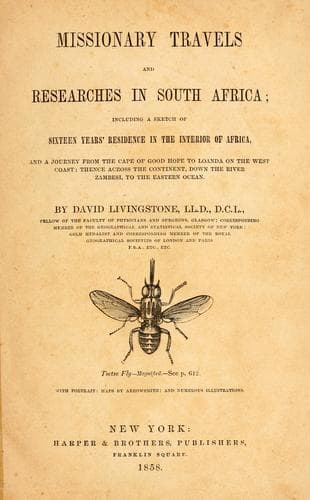
Missionary Travels and Researches in South AfricaLivingstone, David
Religion
Missionary Travels and Researches in South Africa
Livingstone, David
Missions -- South Africa; South Africa -- Description and travel
withstand the effects of climate might prove of value in the more arid
parts of the Cape colony, grapes being well known to be an excellent
restorative in the debility produced by heat: by ingrafting, or by some
of those curious manipulations which we read of in books on gardening, a
variety might be secured better adapted to the country than the foreign
vines at present cultivated. The Americans find that some of their
native vines yield wines superior to those made from the very best
imported vines from France and Portugal. What a boon a vine of the sort
contemplated would have been to a Rhenish missionary I met at a part in
the west of the colony called Ebenezer, whose children had never seen
flowers, though old enough to talk about them!
The slow pace at which we wound our way through the colony made almost
any subject interesting. The attention is attracted to the names
of different places, because they indicate the former existence of
buffaloes, elands, and elephants, which are now to be found only
hundreds of miles beyond. A few blesbucks ('Antilope pygarga'), gnus,
bluebucks ('A. cerulea'), steinbucks, and the ostrich ('Struthio
camelus'), continue, like the Bushmen, to maintain a precarious
existence when all the rest are gone. The elephant, the most sagacious,
flees the sound of fire-arms first; the gnu and ostrich, the most wary
and the most stupid, last. The first emigrants found the Hottentots in
possession of prodigious herds of fine cattle, but no horses, asses, or
camels. The original cattle, which may still be seen in some parts of
the frontier, must have been brought south from the north-northeast,
for from this point the natives universally ascribe their original
migration. They brought cattle, sheep, goats, and dogs; why not the
horse, the delight of savage hordes? Horses thrive well in the Cape
Colony when imported. Naturalists point out certain mountain ranges
as limiting the habitat of certain classes of animals; but there is
no Cordillera in Africa to answer that purpose, there being no visible
barrier between the northeastern Arabs and the Hottentot tribes to
prevent the different hordes, as they felt their way southward, from
indulging their taste for the possession of this noble animal.
Public-domain text, read in full here on John Shaqi.
Reviews
Reviews
No reviews yet
Be the first to share your thoughts on this work.
Elsewhere in the archive
Join the Discussion
Join the discussion
Sign in to leave a comment or review.
Sign InorCreate an account