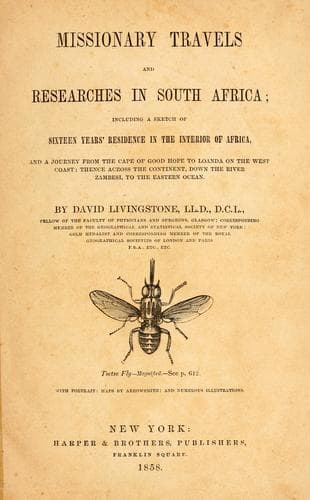
Missionary Travels and Researches in South AfricaLivingstone, David
Religion
Missionary Travels and Researches in South Africa
Livingstone, David
Missions -- South Africa; South Africa -- Description and travel
On the 31st of December, 1852, we reached the town of Sechele, called,
from the part of the range on which it is situated, Litubaruba. Near
the village there exists a cave named Lepelole; it is an interesting
evidence of the former existence of a gushing fountain. No one dared to
enter the Lohaheng, or cave, for it was the common belief that it was
the habitation of the Deity. As we never had a holiday from January to
December, and our Sundays were the periods of our greatest exertions in
teaching, I projected an excursion into the cave on a week-day to see
the god of the Bakwains. The old men said that every one who went in
remained there forever, adding, "If the teacher is so mad as to kill
himself, let him do so alone, we shall not be to blame." The declaration
of Sechele, that he would follow where I led, produced the greatest
consternation. It is curious that in all their pretended dreams or
visions of their god he has always a crooked leg, like the Egyptian
Thau. Supposing that those who were reported to have perished in this
cave had fallen over some precipice, we went well provided with lights,
ladder, lines, &c.; but it turned out to be only an open cave, with
an entrance about ten feet square, which contracts into two water-worn
branches, ending in round orifices through which the water once flowed.
The only inhabitants it seems ever to have had were baboons. I left
at the end of the upper branch one of Father Mathew's leaden teetotal
tickets.
I never saw the Bakwains looking so haggard and lean as at this time.
Most of their cattle had been swept away by the Boers, together with
about eighty fine draught oxen; and much provision left with them by
two officers, Captains Codrington and Webb, to serve for their return
journey south, had been carried off also. On their return these officers
found the skeletons of the Bakwains where they expected to find their
own goods. All the corn, clothing, and furniture of the people, too,
had been consumed in the flames which the Boers had forced the subject
tribes to apply to the town during the fight, so that its inhabitants
were now literally starving.
Sechele had given orders to his people not to commit any act of revenge
pending his visit to the Queen of England; but some of the young men
ventured to go to meet a party of Boers returning from hunting, and,
as the Boers became terrified and ran off, they brought their wagons to
Litubaruba. This seems to have given the main body of Boers an idea that
the Bakwains meant to begin a guerrilla war upon them. This "Caffre war"
was, however, only in embryo, and not near that stage of development in
which the natives have found out that the hide-and-seek system is the
most successful.
Public-domain text, read in full here on John Shaqi.
Reviews
Reviews
No reviews yet
Be the first to share your thoughts on this work.
Elsewhere in the archive
Join the Discussion
Join the discussion
Sign in to leave a comment or review.
Sign InorCreate an account