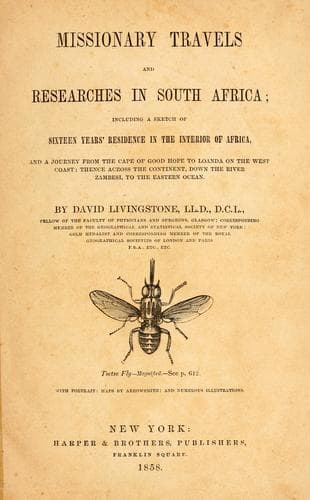
Missionary Travels and Researches in South AfricaLivingstone, David
Religion
Missionary Travels and Researches in South Africa
Livingstone, David
Missions -- South Africa; South Africa -- Description and travel
In conversation with some of my friends here I learned that Maleke, a
chief of the Bakwains, who formerly lived on the hill Litubaruba, had
been killed by the bite of a mad dog. My curiosity was strongly excited
by this statement, as rabies is so rare in this country. I never heard
of another case, and could not satisfy myself that even this was real
hydrophobia. While I was at Mabotsa, some dogs became affected by a
disease which led them to run about in an incoherent state; but I doubt
whether it was any thing but an affection of the brain. No individual
or animal got the complaint by inoculation from the animals' teeth;
and from all that I could hear, the prevailing idea of hydrophobia not
existing within the tropics seems to be quite correct.
The diseases known among the Bakwains are remarkably few. There is
no consumption nor scrofula, and insanity and hydrocephalus are rare.
Cancer and cholera are quite unknown. Small-pox and measles passed
through the country about twenty years ago, and committed great ravages;
but, though the former has since broken out on the coast repeatedly,
neither disease has since traveled inland. For small-pox, the natives
employed, in some parts, inoculation in the forehead with some animal
deposit; in other parts, they employed the matter of the small-pox
itself; and in one village they seem to have selected a virulent case
for the matter used in the operation, for nearly all the village was
swept off by the disease in a malignant confluent form. Where the idea
came from I can not conceive. It was practiced by the Bakwains at a
time when they had no intercourse, direct or indirect, with the southern
missionaries. They all adopt readily the use of vaccine virus when it is
brought within their reach.
A certain loathsome disease, which decimates the North American Indians,
and threatens extirpation to the South Sea Islanders, dies out in the
interior of Africa without the aid of medicine; and the Bangwaketse, who
brought it from the west coast, lost it when they came into their own
land southwest of Kolobeng. It seems incapable of permanence in any form
in persons of pure African blood any where in the centre of the country.
In persons of mixed blood it is otherwise; and the virulence of the
secondary symptoms seemed to be, in all the cases that came under my
care, in exact proportion to the greater or less amount of European
blood in the patient. Among the Corannas and Griquas of mixed breed it
produces the same ravages as in Europe; among half-blood Portuguese it
is equally frightful in its inroads on the system; but in the pure Negro
of the central parts it is quite incapable of permanence. Among the
Barotse I found a disease called manassah, which closely resembles that
of the 'foeda mulier' of history.
Public-domain text, read in full here on John Shaqi.
Reviews
Reviews
No reviews yet
Be the first to share your thoughts on this work.
Elsewhere in the archive
Join the Discussion
Join the discussion
Sign in to leave a comment or review.
Sign InorCreate an account