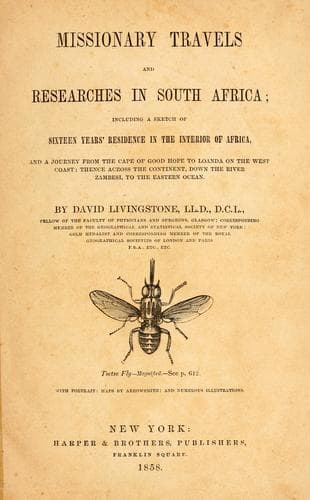
Missionary Travels and Researches in South AfricaLivingstone, David
Religion
Missionary Travels and Researches in South Africa
Livingstone, David
Missions -- South Africa; South Africa -- Description and travel
Mr. Oswell thought this climate much superior to that of Peru, as far as
pleasure is concerned; the want of instruments unfortunately prevented
my obtaining accurate scientific data for the medical world on this
subject; and were it not for the great expense of such a trip, I should
have no hesitation in recommending the borders of the Kalahari Desert as
admirably suited for all patients having pulmonary complaints. It is
the complete antipodes to our cold, damp, English climate. The winter
is perfectly dry; and as not a drop of rain falls during that period,
namely, from the beginning of May to the end of August, damp and cold
are never combined. However hot the day may have been at Kolobeng--and
the thermometer sometimes rose, previous to a fall of rain, up to 96
Deg. in the coolest part of our house--yet the atmosphere never has that
steamy feeling nor those debilitating effects so well known in India
and on the coast of Africa itself. In the evenings the air becomes
deliciously cool, and a pleasant refreshing night follows the hottest
day. The greatest heat ever felt is not so oppressive as it is when
there is much humidity in the air; and the great evaporation consequent
on a fall of rain makes the rainy season the most agreeable for
traveling. Nothing can exceed the balmy feeling of the evenings and
mornings during the whole year. You wish for an increase neither of
cold nor heat; and you can sit out of doors till midnight without ever
thinking of colds or rheumatism; or you may sleep out at night, looking
up to the moon till you fall asleep, without a thought or sign of
moon-blindness. Indeed, during many months there is scarcely any dew.
Chapter 7.
Departure from the Country of the Bakwains--Large black Ant--Land
Tortoises--Diseases of wild Animals--Habits of old Lions--Cowardice of
the Lion--Its Dread of a Snare--Major Vardon's Note--The Roar of
the Lion resembles the Cry of the Ostrich--Seldom attacks full-grown
Animals--Buffaloes and Lions--Mice--Serpents--Treading on
one--Venomous and harmless Varieties--Fascination--Sekomi's Ideas
of Honesty--Ceremony of the Sechu for Boys--The Boyale for
young Women--Bamangwato Hills--The Unicorn's Pass--The Country
beyond--Grain--Scarcity of Water--Honorable Conduct of English
Gentlemen--Gordon Cumming's hunting Adventures--A Word of Advice
for young Sportsmen--Bushwomen drawing Water--Ostrich--Silly
Habit--Paces--Eggs--Food.
Having remained five days with the wretched Bakwains, seeing the effects
of war, of which only a very inadequate idea can ever be formed by those
who have not been eye-witnesses of its miseries, we prepared to depart
on the 15th of January, 1853. Several dogs, in better condition by far
than any of the people, had taken up their residence at the water. No
one would own them; there they had remained, and, coming on the trail
of the people, long after their departure from the scene of conflict, it
was plain they had
"Held o'er the dead their carnival."
Public-domain text, read in full here on John Shaqi.
Reviews
Reviews
No reviews yet
Be the first to share your thoughts on this work.
Elsewhere in the archive
Join the Discussion
Join the discussion
Sign in to leave a comment or review.
Sign InorCreate an account