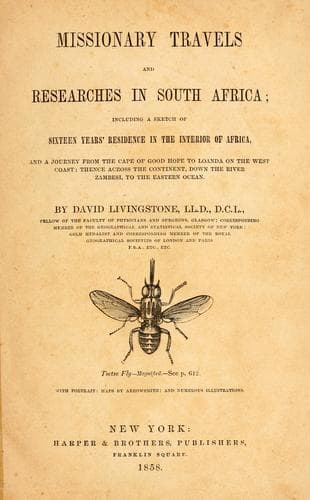
Missionary Travels and Researches in South AfricaLivingstone, David
Religion
Missionary Travels and Researches in South Africa
Livingstone, David
Missions -- South Africa; South Africa -- Description and travel
In general the lion seizes the animal he is attacking by the flank near
the hind leg, or by the throat below the jaw. It is questionable whether
he ever attempts to seize an animal by the withers. The flank is the
most common point of attack, and that is the part he begins to feast
on first. The natives and lions are very similar in their tastes in the
selection of tit-bits: an eland may be seen disemboweled by a lion so
completely that he scarcely seems cut up at all. The bowels and fatty
parts form a full meal for even the largest lion. The jackal comes
sniffing about, and sometimes suffers for his temerity by a stroke from
the lion's paw laying him dead. When gorged, the lion falls fast asleep,
and is then easily dispatched. Hunting a lion with dogs involves very
little danger as compared with hunting the Indian tiger, because the
dogs bring him out of cover and make him stand at bay, giving the hunter
plenty of time for a good deliberate shot.
Where game is abundant, there you may expect lions in proportionately
large numbers. They are never seen in herds, but six or eight, probably
one family, occasionally hunt together. One is in much more danger of
being run over when walking in the streets of London, than he is of
being devoured by lions in Africa, unless engaged in hunting the animal.
Indeed, nothing that I have seen or heard about lions would constitute a
barrier in the way of men of ordinary courage and enterprise.
The same feeling which has induced the modern painter to caricature the
lion, has led the sentimentalist to consider the lion's roar the most
terrific of all earthly sounds. We hear of the "majestic roar of the
king of beasts." It is, indeed, well calculated to inspire fear if
you hear it in combination with the tremendously loud thunder of that
country, on a night so pitchy dark that every flash of the intensely
vivid lightning leaves you with the impression of stone-blindness, while
the rain pours down so fast that your fire goes out, leaving you without
the protection of even a tree, or the chance of your gun going off.
But when you are in a comfortable house or wagon, the case is very
different, and you hear the roar of the lion without any awe or alarm.
The silly ostrich makes a noise as loud, yet he never was feared by man.
To talk of the majestic roar of the lion is mere majestic twaddle. On
my mentioning this fact some years ago, the assertion was doubted, so I
have been careful ever since to inquire the opinions of Europeans, who
have heard both, if they could detect any difference between the roar
of a lion and that of an ostrich; the invariable answer was, that they
could not when the animal was at any distance. The natives assert that
they can detect a variation between the commencement of the noise of
each. There is, it must be admitted, considerable difference between
the singing noise of a lion when full, and his deep, gruff growl when
hungry.
Public-domain text, read in full here on John Shaqi.
Reviews
Reviews
No reviews yet
Be the first to share your thoughts on this work.
Elsewhere in the archive
Join the Discussion
Join the discussion
Sign in to leave a comment or review.
Sign InorCreate an account