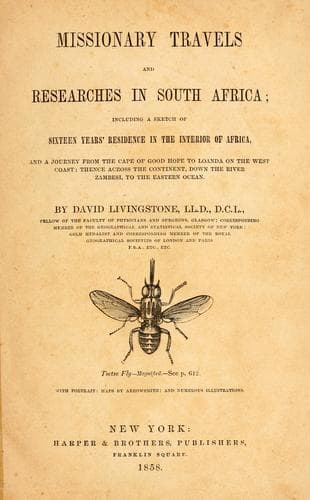
Missionary Travels and Researches in South AfricaLivingstone, David
Religion
Missionary Travels and Researches in South Africa
Livingstone, David
Missions -- South Africa; South Africa -- Description and travel
In the "koha" the same respect is shown to age as in many other of their
customs. A younger man, rushing from the ranks to exercise his wand on
the backs of the youths, may be himself the object of chastisement by
the older, and, on the occasion referred to, Sekomi received a severe
cut on the leg from one of his gray-haired people. On my joking with
some of the young men on their want of courage, notwithstanding all the
beatings of which they bore marks, and hinting that our soldiers were
brave without suffering so much, one rose up and said, "Ask him if, when
he and I were compelled by a lion to stop and make a fire, I did not lie
down and sleep as well as himself." In other parts a challenge to try
a race would have been given, and you may frequently see grown men
adopting that means of testing superiority, like so many children.
The sechu is practiced by three tribes only. Boguera is observed by all
the Bechuanas and Caffres, but not by the negro tribes beyond 20 Deg.
south. The "boguera" is a civil rather than a religious rite. All the
boys of an age between ten and fourteen or fifteen are selected to be
the companions for life of one of the sons of the chief. They are taken
out to some retired spot in the forest, and huts are erected for their
accommodation; the old men go out and teach them to dance, initiating
them, at the same time, into all the mysteries of African politics and
government. Each one is expected to compose an oration in praise of
himself, called a "leina" or name, and to be able to repeat it with
sufficient fluency. A good deal of beating is required to bring them
up to the required excellency in different matters, so that, when
they return from the close seclusion in which they are kept, they have
generally a number of scars to show on their backs. These bands or
regiments, named mepato in the plural and mopato in the singular,
receive particular appellations; as, the Matsatsi--the suns; the
Mabusa--the rulers; equivalent to our Coldstreams or Enniskillens; and,
though living in different parts of the town, they turn out at the call,
and act under the chief's son as their commander. They recognize a sort
of equality and partial communism ever afterward, and address each other
by the title of molekane or comrade. In cases of offence against their
rules, as eating alone when any of their comrades are within call, or in
cases of cowardice or dereliction of duty, they may strike one another,
or any member of a younger mopato, but never any one of an older band;
and when three or four companies have been made, the oldest no longer
takes the field in time of war, but remains as a guard over the women
and children. When a fugitive comes to a tribe, he is directed to the
mopato analogous to that to which in his own tribe he belongs, and does
duty as a member. No one of the natives knows how old he is. If asked
his age, he answers by putting another question, "Does a man remember
Public-domain text, read in full here on John Shaqi.
Reviews
Reviews
No reviews yet
Be the first to share your thoughts on this work.
Elsewhere in the archive
Join the Discussion
Join the discussion
Sign in to leave a comment or review.
Sign InorCreate an account