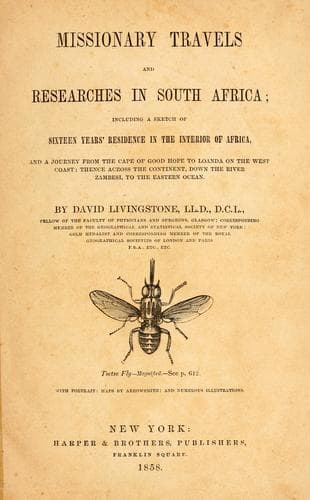
Missionary Travels and Researches in South AfricaLivingstone, David
Religion
Missionary Travels and Researches in South Africa
Livingstone, David
Missions -- South Africa; South Africa -- Description and travel
We wished to avoid the tsetse of our former path, so kept a course on
the magnetic meridian from Lurilopepe. The necessity of making a new
path much increased our toil. We were, however, rewarded in lat. 18
Degrees with a sight we had not enjoyed the year before, namely, large
patches of grape-bearing vines. There they stood before my eyes; but the
sight was so entirely unexpected that I stood some time gazing at the
clusters of grapes with which they were loaded, with no more thought of
plucking than if I had been beholding them in a dream. The Bushmen know
and eat them; but they are not well flavored on account of the great
astringency of the seeds, which are in shape and size like split peas.
The elephants are fond of the fruit, plant, and root alike. I here found
an insect which preys on ants; it is about an inch and a quarter long,
as thick as a crow-quill, and covered with black hair. It puts its head
into a little hole in the ground, and quivers its tail rapidly; the ants
come near to see it, and it snaps up each as he comes within the range
of the forceps on its tail. As its head is beneath the ground, it
becomes a question how it can guide its tail to the ants. It is probably
a new species of ant-lion ('Myrmeleon formicaleo'), great numbers of
which, both in the larvae and complete state, are met with. The ground
under every tree is dotted over with their ingenious pitfalls, and the
perfect insect, the form of which most persons are familiar with in the
dragon-fly, may be seen using its tail in the same active manner as
this insect did. Two may be often seen joined in their flight, the
one holding on by the tail-forceps to the neck of the other. On first
observing this imperfect insect, I imagined the forceps were on its
head; but when the insect moved, their true position was seen.
The forest, through which we were slowly toiling, daily became more
dense, and we were kept almost constantly at work with the axe; there
was much more leafiness in the trees here than farther south. The leaves
are chiefly of the pinnate and bi-pinnate forms, and are exceedingly
beautiful when seen against the sky; a great variety of the
papilionaceous family grow in this part of the country.
Public-domain text, read in full here on John Shaqi.
Reviews
Reviews
No reviews yet
Be the first to share your thoughts on this work.
Elsewhere in the archive
Join the Discussion
Join the discussion
Sign in to leave a comment or review.
Sign InorCreate an account