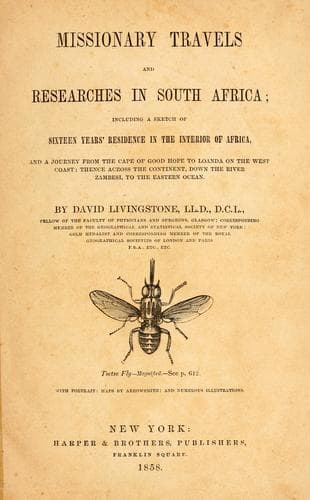
Missionary Travels and Researches in South AfricaLivingstone, David
Religion
Missionary Travels and Researches in South Africa
Livingstone, David
Missions -- South Africa; South Africa -- Description and travel
As the Bushmen have the reputation of curing the wounds of this poison,
I asked how this was effected. They said that they administer the
caterpillar itself in combination with fat; they also rub fat into the
wound, saying that "the N'gwa wants fat, and, when it does not find
it in the body, kills the man: we give it what it wants, and it is
content:" a reason which will commend itself to the enlightened among
ourselves.
The poison more generally employed is the milky juice of the tree
Euphorbia ('E. arborescens'). This is particularly obnoxious to the
equine race. When a quantity is mixed with the water of a pond a whole
herd of zebras will fall dead from the effects of the poison before they
have moved away two miles. It does not, however, kill oxen or men. On
them it acts as a drastic purgative only. This substance is used all
over the country, though in some places the venom of serpents and a
certain bulb, 'Amaryllis toxicaria', are added, in order to increase the
virulence.
Father Pedro, a Jesuit, who lived at Zumbo, made a balsam, containing a
number of plants and CASTOR OIL, as a remedy for poisoned arrow-wounds.
It is probable that he derived his knowledge from the natives as I
did, and that the reputed efficacy of the balsam is owing to its fatty
constituent.
In cases of the bites of serpents a small key ought to be pressed
down firmly on the wound, the orifice of the key being applied to the
puncture, until a cupping-glass can be got from one of the natives. A
watch-key pressed firmly on the point stung by a scorpion extracts the
poison, and a mixture of fat or oil and ipecacuanha relieves the pain.
The Bushmen of these districts are generally fine, well-made men, and
are nearly independent of every one. We observed them to be fond of
a root somewhat like a kidney potato, and the kernel of a nut, which
Fleming thought was a kind of betel; the tree is a fine, large-spreading
one, and the leaves palmate. From the quantities of berries and the
abundance of game in these parts, the Bushmen can scarcely ever be
badly off for food. As I could, without much difficulty, keep them well
supplied with meat, and wished them to remain, I proposed that they
should bring their wives to get a share, but they remarked that the
women could always take care of themselves.
Public-domain text, read in full here on John Shaqi.
Reviews
Reviews
No reviews yet
Be the first to share your thoughts on this work.
Elsewhere in the archive
Join the Discussion
Join the discussion
Sign in to leave a comment or review.
Sign InorCreate an account