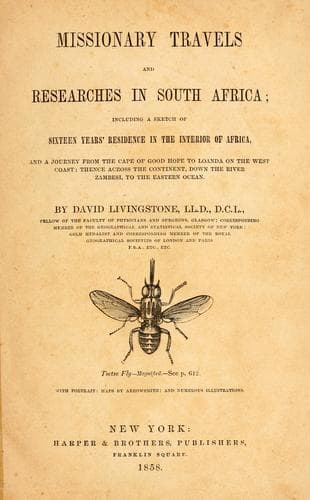
Missionary Travels and Researches in South AfricaLivingstone, David
Religion
Missionary Travels and Researches in South Africa
Livingstone, David
Missions -- South Africa; South Africa -- Description and travel
The court herald, an old man who occupied the post also in Sebituane's
time, stood up, and after some antics, such as leaping, and shouting at
the top of his voice, roared out some adulatory sentences, as, "Don't I
see the white man? Don't I see the comrade of Sebituane? Don't I see the
father of Sekeletu?"--"We want sleep."--"Give your son sleep, my lord,"
etc., etc. The perquisites of this man are the heads of all the cattle
slaughtered by the chief, and he even takes a share of the tribute
before it is distributed and taken out of the kotla. He is expected to
utter all the proclamations, call assemblies, keep the kotla clean, and
the fire burning every evening, and when a person is executed in public
he drags away the body.
I found Sekeletu a young man of eighteen years of age, of that dark
yellow or coffee-and-milk color, of which the Makololo are so proud,
because it distinguishes them considerably from the black tribes on
the rivers. He is about five feet seven in height, and neither so
good looking nor of so much ability as his father was, but is equally
friendly to the English. Sebituane installed his daughter Mamochisane
into the chieftainship long before his death, but, with all his
acuteness, the idea of her having a husband who should not be her lord
did not seem to enter his mind. He wished to make her his successor,
probably in imitation of some of the negro tribes with whom he had come
into contact; but, being of the Bechuana race, he could not look upon
the husband except as the woman's lord; so he told her all the men
were hers--she might take any one, but ought to keep none. In fact, he
thought she might do with the men what he could do with the women; but
these men had other wives; and, according to a saying in the country,
"the tongues of women can not be governed," they made her miserable by
their remarks. One man whom she chose was even called her wife, and
her son the child of Mamochisane's wife; but the arrangement was so
distasteful to Mamochisane herself that, as soon as Sebituane died, she
said she never would consent to govern the Makololo so long as she had a
brother living. Sekeletu, being afraid of another member of the family,
Mpepe, who had pretensions to the chieftainship, urged his sister
strongly to remain as she had always been, and allow him to support her
authority by leading the Makololo when they went forth to war. Three
days were spent in public discussion on the point. Mpepe insinuated that
Sekeletu was not the lawful son of Sebituane, on account of his
mother having been the wife of another chief before her marriage with
Sebituane; Mamochisane, however, upheld Sekeletu's claims, and at last
stood up in the assembly and addressed him with a womanly gush of tears:
"I have been a chief only because my father wished it. I always would
have preferred to be married and have a family like other women. You,
Sekeletu, must be chief, and build up your father's house." This was a
Public-domain text, read in full here on John Shaqi.
Reviews
Reviews
No reviews yet
Be the first to share your thoughts on this work.
Elsewhere in the archive
Join the Discussion
Join the discussion
Sign in to leave a comment or review.
Sign InorCreate an account