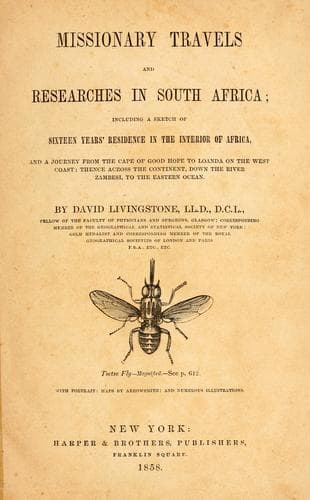
Missionary Travels and Researches in South AfricaLivingstone, David
Religion
Missionary Travels and Researches in South Africa
Livingstone, David
Missions -- South Africa; South Africa -- Description and travel
The Makololo women work but little. Indeed, the families of that nation
are spread over the country, one or two only in each village, as
the lords of the land. They all have lordship over great numbers of
subjected tribes, who pass by the general name Makalaka, and who are
forced to render certain services, and to aid in tilling the soil; but
each has his own land under cultivation, and otherwise lives nearly
independent. They are proud to be called Makololo, but the other term
is often used in reproach, as betokening inferiority. This species of
servitude may be termed serfdom, as it has to be rendered in consequence
of subjection by force of arms, but it is necessarily very mild. It is
so easy for any one who is unkindly treated to make his escape to
other tribes, that the Makololo are compelled to treat them, to a great
extent, rather as children than slaves. Some masters, who fail from
defect of temper or disposition to secure the affections of the
conquered people, frequently find themselves left without a single
servant, in consequence of the absence and impossibility of enforcing
a fugitive-slave law, and the readiness with which those who are
themselves subjected assist the fugitives across the rivers in canoes.
The Makololo ladies are liberal in their presents of milk and other
food, and seldom require to labor, except in the way of beautifying
their own huts and court-yards. They drink large quantities of boyaloa
or o-alo, the buza of the Arabs, which, being made of the grain called
holcus sorghum or "durasaifi", in a minute state of subdivision, is
very nutritious, and gives that plumpness of form which is considered
beautiful. They dislike being seen at their potations by persons of the
opposite sex. They cut their woolly hair quite short, and delight in
having the whole person shining with butter. Their dress is a kilt
reaching to the knees; its material is ox-hide, made as soft as cloth.
It is not ungraceful. A soft skin mantle is thrown across the shoulders
when the lady is unemployed, but when engaged in any sort of labor
she throws this aside, and works in the kilt alone. The ornaments most
coveted are large brass anklets as thick as the little finger, and
armlets of both brass and ivory, the latter often an inch broad. The
rings are so heavy that the ankles are often blistered by the weight
pressing down; but it is the fashion, and is borne as magnanimously as
tight lacing and tight shoes among ourselves. Strings of beads are hung
around the neck, and the fashionable colors being light green and pink,
a trader could get almost any thing he chose for beads of these colors.
Public-domain text, read in full here on John Shaqi.
Reviews
Reviews
No reviews yet
Be the first to share your thoughts on this work.
Elsewhere in the archive
Join the Discussion
Join the discussion
Sign in to leave a comment or review.
Sign InorCreate an account