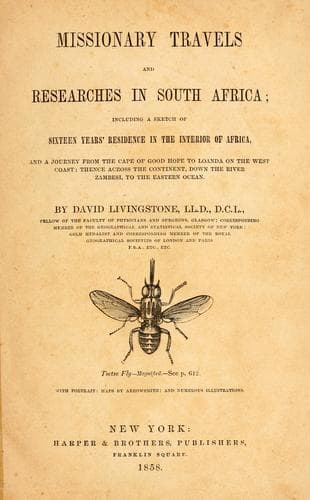
Missionary Travels and Researches in South AfricaLivingstone, David
Religion
Missionary Travels and Researches in South Africa
Livingstone, David
Missions -- South Africa; South Africa -- Description and travel
As I had declined to name any thing as a present from Sekeletu, except a
canoe to take me up the river, he brought ten fine elephants' tusks and
laid them down beside my wagon. He would take no denial, though I told
him I should prefer to see him trading with Fleming, a man of color from
the West Indies, who had come for the purpose. I had, during the eleven
years of my previous course, invariably abstained from taking presents
of ivory, from an idea that a religious instructor degraded himself by
accepting gifts from those whose spiritual welfare he professed to seek.
My precedence of all traders in the line of discovery put me often in
the way of very handsome offers, but I always advised the donors to sell
their ivory to traders, who would be sure to follow, and when at some
future time they had become rich by barter, they might remember me or my
children. When Lake Ngami was discovered I might have refused permission
to a trader who accompanied us; but when he applied for leave to form
part of our company, knowing that Mr. Oswell would no more trade than
myself, and that the people of the lake would be disappointed if they
could not dispose of their ivory, I willingly granted a sanction,
without which his people would not at that time have ventured so far.
This was surely preferring the interest of another to my own. The return
I got for this was a notice in one of the Cape papers that this "man was
the true discoverer of the lake!"
The conclusion I had come to was, that it is quite lawful, though
perhaps not expedient, for missionaries to trade; but barter is the only
means by which a missionary in the interior can pay his way, as money
has no value. In all the journeys I had previously undertaken for wider
diffusion of the Gospel, the extra expenses were defrayed from my salary
of 100 Pounds per annum. This sum is sufficient to enable a missionary
to live in the interior of South Africa, supposing he has a garden
capable of yielding corn and vegetables; but should he not, and still
consider that six or eight months can not lawfully be spent simply
in getting goods at a lower price than they can be had from itinerant
traders, the sum mentioned is barely sufficient for the poorest fare
and plainest apparel. As we never felt ourselves justified in making
journeys to the colony for the sake of securing bargains, the most
frugal living was necessary to enable us to be a little charitable to
others; but when to this were added extra traveling expenses, the wants
of an increasing family, and liberal gifts to chiefs, it was difficult
to make both ends meet. The pleasure of missionary labor would be
enhanced if one could devote his life to the heathen, without drawing
a salary from a society at all. The luxury of doing good from one's own
private resources, without appearing to either natives or Europeans
to be making a gain of it, is far preferable, and an object worthy
the ambition of the rich. But few men of fortune, however, now devote
Public-domain text, read in full here on John Shaqi.
Reviews
Reviews
No reviews yet
Be the first to share your thoughts on this work.
Elsewhere in the archive
Join the Discussion
Join the discussion
Sign in to leave a comment or review.
Sign InorCreate an account