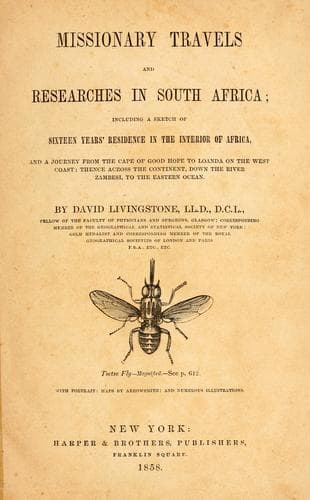
Missionary Travels and Researches in South AfricaLivingstone, David
Religion
Missionary Travels and Researches in South Africa
Livingstone, David
Missions -- South Africa; South Africa -- Description and travel
They have two breeds of cattle among them. One, called the Batoka,
because captured from that tribe, is of diminutive size, but very
beautiful, and closely resembles the short-horns of our own country.
The little pair presented by the King of Portugal to H.R.H. the prince
consort, is of this breed. They are very tame, and remarkably playful;
they may be seen lying on their sides by the fires in the evening; and,
when the herd goes out, the herdsman often precedes them, and has only
to commence capering to set them all a gamboling. The meat is superior
to that of the large animal. The other, or Barotse ox, is much larger,
and comes from the fertile Barotse Valley. They stand high on their
legs, often nearly six feet at the withers; and they have large horns.
Those of one of a similar breed that we brought from the lake measured
from tip to tip eight and a half feet.
The Makololo are in the habit of shaving off a little from one side of
the horns of these animals when still growing, in order to make them
curve in that direction and assume fantastic shapes. The stranger the
curvature, the more handsome the ox is considered to be, and the longer
this ornament of the cattle-pen is spared to beautify the herd. This is
a very ancient custom in Africa, for the tributary tribes of Ethiopia
are seen, on some of the most ancient Egyptian monuments, bringing
contorted-horned cattle into Egypt.
All are remarkably fond of their cattle, and spend much time in
ornamenting and adorning them. Some are branded all over with a hot
knife, so as to cause a permanent discoloration of the hair, in lines
like the bands on the hide of a zebra. Pieces of skin two or three
inches long and broad are detached, and allowed to heal in a dependent
position around the head--a strange style of ornament; indeed, it is
difficult to conceive in what their notion of beauty consists. The
women have somewhat the same ideas with ourselves of what constitutes
comeliness. They came frequently and asked for the looking-glass; and
the remarks they made--while I was engaged in reading, and apparently
not attending to them--on first seeing themselves therein, were
amusingly ridiculous. "Is that me?" "What a big mouth I have!" "My ears
are as big as pumpkin-leaves." "I have no chin at all." Or, "I would
have been pretty, but am spoiled by these high cheek-bones." "See how
my head shoots up in the middle!" laughing vociferously all the time
at their own jokes. They readily perceive any defect in each other, and
give nicknames accordingly. One man came alone to have a quiet gaze at
his own features once, when he thought I was asleep; after twisting his
mouth about in various directions, he remarked to himself, "People say I
am ugly, and how very ugly I am indeed!"
Public-domain text, read in full here on John Shaqi.
Reviews
Reviews
No reviews yet
Be the first to share your thoughts on this work.
Elsewhere in the archive
Join the Discussion
Join the discussion
Sign in to leave a comment or review.
Sign InorCreate an account