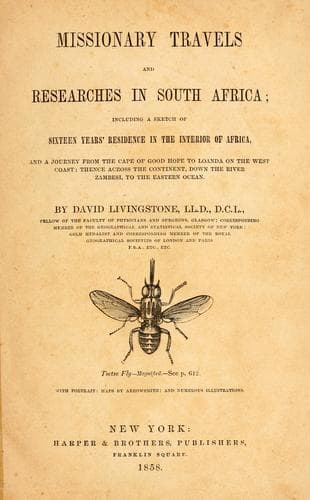
Missionary Travels and Researches in South AfricaLivingstone, David
Religion
Missionary Travels and Researches in South Africa
Livingstone, David
Missions -- South Africa; South Africa -- Description and travel
bunches of black ostrich feathers, or caps made of lions' manes. Some
wore red tunics, or various-colored prints which the chief had bought
from Fleming; the common men carried burdens; the gentlemen walked with
a small club of rhinoceros-horn in their hands, and had servants to
carry their shields; while the "Machaka", battle-axe men, carried their
own, and were liable at any time to be sent off a hundred miles on an
errand, and expected to run all the way.
Sekeletu is always accompanied by his own Mopato, a number of young men
of his own age. When he sits down they crowd around him; those who
are nearest eat out of the same dish, for the Makololo chiefs pride
themselves on eating with their people. He eats a little, then beckons
his neighbors to partake. When they have done so, he perhaps beckons
to some one at a distance to take a share; that person starts forward,
seizes the pot, and removes it to his own companions. The comrades of
Sekeletu, wishing to imitate him in riding on my old horse, leaped
on the backs of a number of half-broken Batoka oxen as they ran, but,
having neither saddle nor bridle, the number of tumbles they met with
was a source of much amusement to the rest. Troops of leches, or, as
they are here called, "lechwes", appeared feeding quite heedlessly
all over the flats; they exist here in prodigious herds, although the
numbers of them and of the "nakong" that are killed annually must be
enormous. Both are water antelopes, and, when the lands we now tread
upon are flooded, they betake themselves to the mounds I have alluded
to. The Makalaka, who are most expert in the management of their small,
thin, light canoes, come gently toward them; the men stand upright in
the canoe, though it is not more than fifteen or eighteen inches wide
and about fifteen feet long; their paddles, ten feet in height, are of
a kind of wood called molompi, very light, yet as elastic as ash. With
these they either punt or paddle, according to the shallowness or depth
of the water. When they perceive the antelopes beginning to move they
increase their speed, and pursue them with great velocity. They make the
water dash away from the gunwale, and, though the leche goes off by a
succession of prodigious bounds, its feet appearing to touch the bottom
at each spring, they manage to spear great numbers of them.
The nakong often shares a similar fate. This is a new species, rather
smaller than the leche, and in shape has more of paunchiness than any
antelope I ever saw. Its gait closely resembles the gallop of a dog
when tired. The hair is long and rather sparse, so that it is never
sleek-looking. It is of a grayish-brown color, and has horns twisted
in the manner of a koodoo, but much smaller, and with a double ridge
winding round each of them.
Public-domain text, read in full here on John Shaqi.
Reviews
Reviews
No reviews yet
Be the first to share your thoughts on this work.
Elsewhere in the archive
Join the Discussion
Join the discussion
Sign in to leave a comment or review.
Sign InorCreate an account