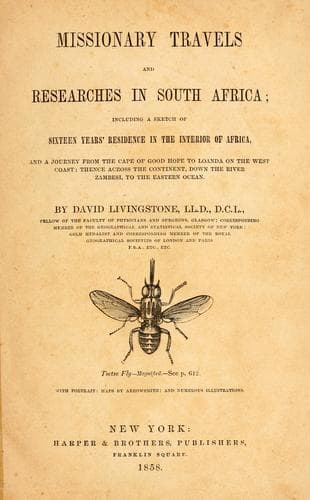
Missionary Travels and Researches in South AfricaLivingstone, David
Religion
Missionary Travels and Researches in South Africa
Livingstone, David
Missions -- South Africa; South Africa -- Description and travel
We proceeded rapidly up the river, and I felt the pleasure of looking
on lands which had never been seen by a European before. The river is,
indeed, a magnificent one, often more than a mile broad, and adorned
with many islands of from three to five miles in length. Both islands
and banks are covered with forest, and most of the trees on the brink of
the water send down roots from their branches like the banian, or 'Ficus
Indica'. The islands at a little distance seem great rounded masses of
sylvan vegetation reclining on the bosom of the glorious stream. The
beauty of the scenery of some of the islands is greatly increased by the
date-palm, with its gracefully curved fronds and refreshing light green
color, near the bottom of the picture, and the lofty palmyra towering
far above, and casting its feathery foliage against a cloudless sky. It
being winter, we had the strange coloring on the banks which many parts
of African landscape assume. The country adjacent to the river is rocky
and undulating, abounding in elephants and all other large game, except
leches and nakongs, which seem generally to avoid stony ground. The soil
is of a reddish color, and very fertile, as is attested by the great
quantity of grain raised annually by the Banyeti. A great many villages
of this poor and very industrious people are situated on both banks of
the river: they are expert hunters of the hippopotami and other animals,
and very proficient in the manufacture of articles of wood and iron. The
whole of this part of the country being infested with the tsetse, they
are unable to rear domestic animals. This may have led to their skill
in handicraft works. Some make large wooden vessels with very neat lids,
and wooden bowls of all sizes; and since the idea of sitting on stools
has entered the Makololo mind, they have shown great taste in the
different forms given to the legs of these pieces of furniture.
Other Banyeti, or Manyeti, as they are called, make neat and strong
baskets of the split roots of a certain tree, while others excel in
pottery and iron. I can not find that they have ever been warlike.
Indeed, the wars in the centre of the country, where no slave-trade
existed, have seldom been about any thing else but cattle. So well known
is this, that several tribes refuse to keep cattle because they tempt
their enemies to come and steal. Nevertheless, they have no objection to
eat them when offered, and their country admits of being well stocked.
I have heard of but one war having occurred from another cause. Three
brothers, Barolongs, fought for the possession of a woman who was
considered worth a battle, and the tribe has remained permanently
divided ever since.
Public-domain text, read in full here on John Shaqi.
Reviews
Reviews
No reviews yet
Be the first to share your thoughts on this work.
Elsewhere in the archive
Join the Discussion
Join the discussion
Sign in to leave a comment or review.
Sign InorCreate an account