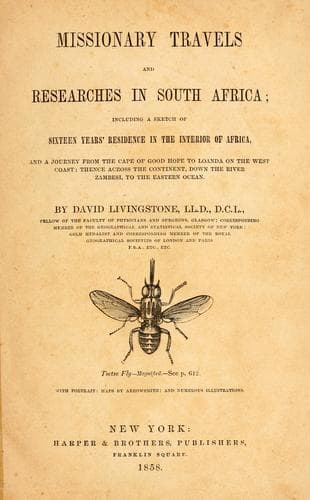
Missionary Travels and Researches in South AfricaLivingstone, David
Religion
Missionary Travels and Researches in South Africa
Livingstone, David
Missions -- South Africa; South Africa -- Description and travel
The river presents the same appearance of low banks without trees as
we have remarked it had after we came to 16d 16', until we arrive at
Libonta (14d 59' S. lat.). Twenty miles beyond that, we find forest down
to the water's edge, and tsetse. Here I might have turned back, as no
locality can be inhabited by Europeans where that scourge exists; but
hearing that we were not far from the confluence of the River of Londa
or Lunda, named Leeba or Loiba, and the chiefs of that country being
reported to be friendly to strangers, and therefore likely to be of use
to me on my return from the west coast, I still pushed on to latitude
14d 11' 3" S. There the Leeambye assumes the name Kabompo, and seems to
be coming from the east. It is a fine large river, about three hundred
yards wide, and the Leeba two hundred and fifty. The Loeti, a branch of
which is called Langebongo, comes from W.N.W., through a level grassy
plain named Mango; it is about one hundred yards wide, and enters the
Leeambye from the west; the waters of the Loeti are of a light color,
and those of the Leeba of a dark mossy hue. After the Loeti joins
the Leeambye the different colored waters flow side by side for some
distance unmixed.
Before reaching the Loeti we came to a number of people from the Lobale
region, hunting hippopotami. They fled precipitately as soon as they saw
the Makololo, leaving their canoes and all their utensils and clothing.
My own Makalaka, who were accustomed to plunder wherever they went,
rushed after them like furies, totally regardless of my shouting. As
this proceeding would have destroyed my character entirely at Lobale, I
took my stand on a commanding position as they returned, and forced them
to lay down all the plunder on a sand-bank, and leave it there for its
lawful owners.
It was now quite evident that no healthy location could be obtained in
which the Makololo would be allowed to live in peace. I had thus a fair
excuse, if I had chosen to avail myself of it, of coming home and saying
that the "door was shut", because the Lord's time had not yet come. But
believing that it was my duty to devote some portion of my life to these
(to me at least) very confiding and affectionate Makololo, I resolved
to follow out the second part of my plan, though I had failed in
accomplishing the first. The Leeba seemed to come from the N. and by
W., or N.N.W.; so, having an old Portuguese map, which pointed out the
Coanza as rising from the middle of the continent in 9 Deg. S. lat., I
thought it probable that, when we had ascended the Leeba (from 14d 11')
two or three degrees, we should then be within one hundred and twenty
miles of the Coanza, and find no difficulty in following it down to the
coast near Loanda. This was the logical deduction; but, as is the
case with many a plausible theory, one of the premises was decidedly
defective. The Coanza, as we afterward found, does not come from any
where near the centre of the country.
Public-domain text, read in full here on John Shaqi.
Reviews
Reviews
No reviews yet
Be the first to share your thoughts on this work.
Elsewhere in the archive
Join the Discussion
Join the discussion
Sign in to leave a comment or review.
Sign InorCreate an account