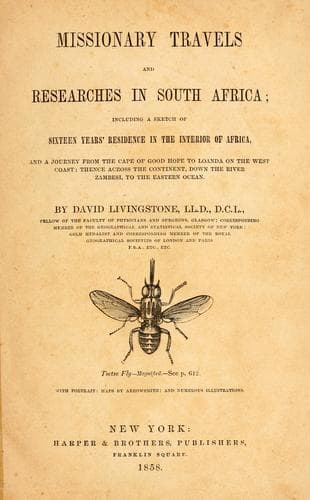
Missionary Travels and Researches in South AfricaLivingstone, David
Religion
Missionary Travels and Researches in South Africa
Livingstone, David
Missions -- South Africa; South Africa -- Description and travel
Accordingly, men were sent at my suggestion to examine all the country
to the west, to see if any belt of country free from tsetse could be
found to afford us an outlet. The search was fruitless. The town
and district of Linyanti are surrounded by forests infested by this
poisonous insect, except at a few points, as that by which we entered
at Sanshureh and another at Sesheke. But the lands both east and west of
the Barotse valley are free from this insect plague. There, however, the
slave-trade had defiled the path, and no one ought to follow in its wake
unless well armed. The Mambari had informed me that many English lived
at Loanda, so I prepared to go thither. The prospect of meeting with
countrymen seemed to overbalance the toils of the longer march.
A "picho" was called to deliberate on the steps proposed. In these
assemblies great freedom of speech is allowed; and on this occasion one
of the old diviners said, "Where is he taking you to? This white man is
throwing you away. Your garments already smell of blood." It is curious
to observe how much identity of character appears all over the world.
This man was a noted croaker. He always dreamed something dreadful in
every expedition, and was certain that an eclipse or comet betokened
the propriety of flight. But Sebituane formerly set his visions down to
cowardice, and Sekeletu only laughed at him now. The general voice was
in my favor; so a band of twenty-seven were appointed to accompany me to
the west. These men were not hired, but sent to enable me to accomplish
an object as much desired by the chief and most of his people as by me.
They were eager to obtain free and profitable trade with white men. The
prices which the Cape merchants could give, after defraying the great
expenses of a long journey hither, being very small, made it scarce
worth while for the natives to collect produce for that market; and the
Mambari, giving only a few bits of print and baize for elephants' tusks
worth more pounds than they gave yards of cloth, had produced the belief
that trade with them was throwing ivory away. The desire of the Makololo
for direct trade with the sea-coast coincided exactly with my own
conviction that no permanent elevation of a people can be effected
without commerce. Neither could there be a permanent mission here,
unless the missionaries should descend to the level of the Makololo, for
even at Kolobeng we found that traders demanded three or four times the
price of the articles we needed, and expected us to be grateful to them
besides for letting us have them at all.
Public-domain text, read in full here on John Shaqi.
Reviews
Reviews
No reviews yet
Be the first to share your thoughts on this work.
Elsewhere in the archive
Join the Discussion
Join the discussion
Sign in to leave a comment or review.
Sign InorCreate an account