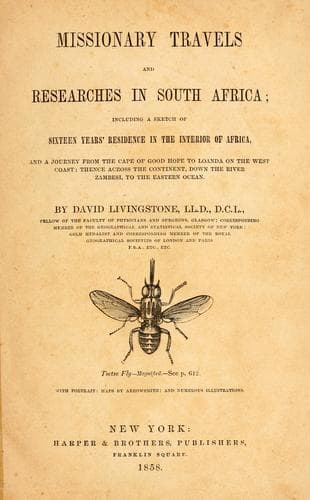
Missionary Travels and Researches in South AfricaLivingstone, David
Religion
Missionary Travels and Researches in South Africa
Livingstone, David
Missions -- South Africa; South Africa -- Description and travel
Among the trees may be observed some species of the 'Ficus Indica',
light-green colored acacias, the splendid motsintsela, and evergreen
cypress-shaped motsouri. The fruit of the last-named was ripe, and the
villagers presented many dishes of its beautiful pink-colored plums;
they are used chiefly to form a pleasant acid drink. The motsintsela is
a very lofty tree, yielding a wood of which good canoes are made;
the fruit is nutritious and good, but, like many wild fruits of this
country, the fleshy parts require to be enlarged by cultivation: it is
nearly all stone.
The course of the river we found to be extremely tortuous; so much so,
indeed, as to carry us to all points of the compass every dozen miles.
Some of us walked from a bend at the village of Moremi to another nearly
due east of that point, in six hours, while the canoes, going at more
than double our speed, took twelve to accomplish the voyage between the
same two places. And though the river is from thirteen to fifteen feet
in depth at its lowest ebb, and broad enough to allow a steamer to ply
upon it, the suddenness of the bendings would prevent navigation;
but, should the country ever become civilized, the Chobe would be a
convenient natural canal. We spent forty-two and a half hours, paddling
at the rate of five miles an hour, in coming from Linyanti to the
confluence; there we found a dike of amygdaloid lying across the
Leeambye.
This amygdaloid with analami and mesotype contains crystals, which
the water gradually dissolves, leaving the rock with a worm-eaten
appearance. It is curious to observe that the water flowing over certain
rocks, as in this instance, imbibes an appreciable, though necessarily
most minute, portion of the minerals they contain. The water of the
Chobe up to this point is of a dark mossy hue, but here it suddenly
assumes a lighter tint; and wherever this light color shows a greater
amount of mineral, there are not mosquitoes enough to cause serious
annoyance to any except persons of very irritable temperaments.
The large island called Mparia stands at the confluence. This is
composed of trap (zeolite, probably mesotype) of a younger age than the
deep stratum of tufa in which the Chobe has formed its bed, for, at
the point where they come together, the tufa has been transformed into
saccharoid limestone.
Public-domain text, read in full here on John Shaqi.
Reviews
Reviews
No reviews yet
Be the first to share your thoughts on this work.
Elsewhere in the archive
Join the Discussion
Join the discussion
Sign in to leave a comment or review.
Sign InorCreate an account