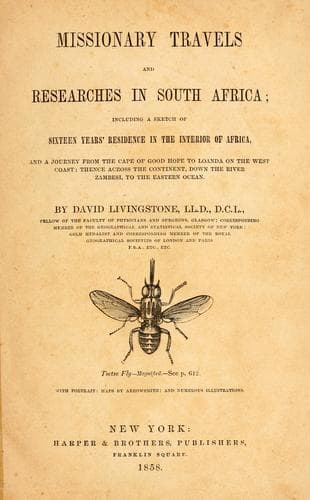
Missionary Travels and Researches in South AfricaLivingstone, David
Religion
Missionary Travels and Researches in South Africa
Livingstone, David
Missions -- South Africa; South Africa -- Description and travel
I taught several of them to wash my shirts, and they did it well, though
their teacher had never been taught that work himself. Frequent changes
of linen and sunning of my blanket kept me more comfortable than
might have been anticipated, and I feel certain that the lessons of
cleanliness rigidly instilled by my mother in childhood helped to
maintain that respect which these people entertain for European ways.
It is questionable if a descent to barbarous ways ever elevates a man in
the eyes of savages.
When quite beyond the inhabited parts, we found the country abounding in
animal life of every form. There are upward of thirty species of birds
on the river itself. Hundreds of the 'Ibis religiosa' come down the
Leeambye with the rising water, as they do on the Nile; then large white
pelicans, in flocks of three hundred at a time, following each other
in long extending line, rising and falling as they fly so regularly
all along as to look like an extended coil of birds; clouds of a black
shell-eating bird, called linongolo ('Anastomus lamelligerus'); also
plovers, snipes, curlews, and herons without number.
There are, besides the more common, some strange varieties. The pretty
white 'ardetta' is seen in flocks, settling on the backs of large herds
of buffaloes, and following them on the wing when they run; while the
kala ('Textor erythrorhynchus') is a better horseman, for it sits on the
withers when the animal is at full speed.
Then those strange birds, the scissor-bills, with snow-white breast,
jet-black coat, and red beak, sitting by day on the sand-banks, the very
picture of comfort and repose. Their nests are only little hollows made
on these same sand-banks, without any attempt of concealment; they watch
them closely, and frighten away the marabou and crows from their eggs
by feigned attacks at their heads. When man approaches their nests, they
change their tactics, and, like the lapwing and ostrich, let one wing
drop and make one leg limp, as if lame. The upper mandible being so much
shorter than the lower, the young are more helpless than the stork in
the fable with the flat dishes, and must have every thing conveyed into
the mouth by the parents till they are able to provide for themselves.
The lower mandible, as thin as a paper-knife, is put into the water
while the bird skims along the surface, and scoops up any little insects
it meets. It has great length of wing, and can continue its flight with
perfect ease, the wings acting, though kept above the level of the body.
The wonder is, how this plowing of the surface of the water can be so
well performed as to yield a meal, for it is usually done in the dark.
Like most aquatic feeders, they work by night, when insects and fishes
rise to the surface. They have great affection for their young,
its amount being increased in proportion to the helplessness of the
offspring.
Public-domain text, read in full here on John Shaqi.
Reviews
Reviews
No reviews yet
Be the first to share your thoughts on this work.
Elsewhere in the archive
Join the Discussion
Join the discussion
Sign in to leave a comment or review.
Sign InorCreate an account