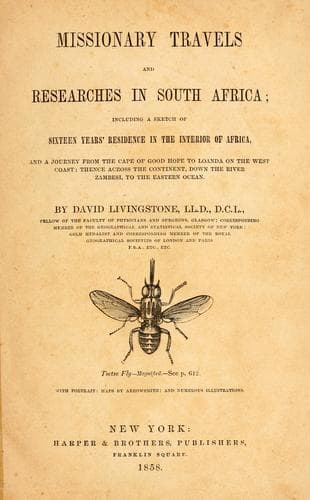
Missionary Travels and Researches in South AfricaLivingstone, David
Religion
Missionary Travels and Researches in South Africa
Livingstone, David
Missions -- South Africa; South Africa -- Description and travel
When we had gone thirty or forty miles above Libonta we sent eleven
of our captives to the west, to the chief called Makoma, with an
explanatory message. This caused some delay; but as we were loaded
with presents of food from the Makololo, and the wild animals were in
enormous herds, we fared sumptuously. It was grievous, however, to
shoot the lovely creatures, they were so tame. With but little skill
in stalking, one could easily get within fifty or sixty yards of them.
There I lay, looking at the graceful forms and motions of beautiful
pokus,* leches, and other antelopes, often till my men, wondering what
was the matter, came up to see, and frightened them away. If we had been
starving, I could have slaughtered them with as little hesitation as I
should cut off a patient's leg; but I felt a doubt, and the antelopes
got the benefit of it. Have they a guardian spirit over them? I have
repeatedly observed, when I approached a herd lying beyond an ant-hill
with a tree on it, and viewed them with the greatest caution, they very
soon showed symptoms of uneasiness. They did not sniff danger in
the wind, for I was to leeward of them; but the almost invariable
apprehension of danger which arose, while unconscious of the direction
in which it lay, made me wonder whether each had what the ancient
physicians thought we all possessed, an archon, or presiding spirit.
* I propose to name this new species 'Antilope Vardonii',
after the African traveler, Major Vardon.
If we could ascertain the most fatal spot in an animal, we could
dispatch it with the least possible amount of suffering; but as that is
probably the part to which the greatest amount of nervous influence is
directed at the moment of receiving the shot, if we can not be sure of
the heart or brain, we are never certain of speedy death. Antelopes,
formed for a partially amphibious existence, and other animals of that
class, are much more tenacious of life than those which are purely
terrestrial. Most antelopes, when in distress or pursued, make for the
water. If hunted, they always do. A leche shot right through the body,
and no limb-bone broken, is almost sure to get away, while a zebra, with
a wound of no greater severity, will probably drop down dead. I have
seen a rhinoceros, while standing apparently chewing the cud, drop down
dead from a shot in the stomach, while others shot through one lung
and the stomach go off as if little hurt. But if one should crawl up
silently to within twenty yards either of the white or black rhinoceros,
throwing up a pinch of dust every now and then, to find out that the
anxiety to keep the body concealed by the bushes has not led him to
the windward side, then sit down, rest the elbow on the knees, and aim,
slanting a little upward, at a dark spot behind the shoulders, it falls
stone dead.
Public-domain text, read in full here on John Shaqi.
Reviews
Reviews
No reviews yet
Be the first to share your thoughts on this work.
Elsewhere in the archive
Join the Discussion
Join the discussion
Sign in to leave a comment or review.
Sign InorCreate an account