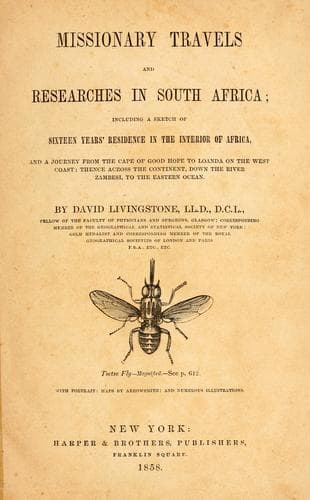
Missionary Travels and Researches in South AfricaLivingstone, David
Religion
Missionary Travels and Researches in South Africa
Livingstone, David
Missions -- South Africa; South Africa -- Description and travel
I shall not often advert to their depravity. My practice has always been
to apply the remedy with all possible earnestness, but never allow my
own mind to dwell on the dark shades of men's characters. I have never
been able to draw pictures of guilt, as if that could awaken Christian
sympathy. The evil is there. But all around in this fair creation are
scenes of beauty, and to turn from these to ponder on deeds of sin can
not promote a healthy state of the faculties. I attribute much of the
bodily health I enjoy to following the plan adopted by most physicians,
who, while engaged in active, laborious efforts to assist the needy,
at the same time follow the delightful studies of some department of
natural history. The human misery and sin we endeavor to alleviate and
cure may be likened to the sickness and impurity of some of the back
slums of great cities. One contents himself by ministering to the sick
and trying to remove the causes, without remaining longer in the filth
than is necessary for his work; another, equally anxious for the public
good, stirs up every cesspool, that he may describe its reeking vapors,
and, by long contact with impurities, becomes himself infected, sickens,
and dies.
The men went about during the day, and brought back wild fruits of
several varieties, which I had not hitherto seen. One, called mogametsa,
is a bean with a little pulp round it, which tastes like sponge-cake;
another, named mawa, grows abundantly on a low bush. There are many
berries and edible bulbs almost every where. The mamosho or moshomosho,
and milo (a medlar), were to be found near our encampment. These are
both good, if indeed one can be a fair judge who felt quite disposed to
pass a favorable verdict on every fruit which had the property of being
eatable at all. Many kinds are better than our crab-apple or sloe, and,
had they the care and culture these have enjoyed, might take high rank
among the fruits of the world. All that the Africans have thought of has
been present gratification; and now, as I sometimes deposit date-seeds
in the soil, and tell them I have no hope whatever of seeing the fruit,
it seems to them as the act of the South Sea Islanders appears to us,
when they planted in their gardens iron nails received from Captain
Cook.
There are many fruits and berries in the forests, the uses of which are
unknown to my companions. Great numbers of a kind of palm I have never
met with before were seen growing at and below the confluence of the
Loeti and Leeambye; the seed probably came down the former river. It is
nearly as tall as the palmyra. The fruit is larger than of that species;
it is about four inches long, and has a soft yellow pulp round the
kernel or seed; when ripe, it is fluid and stringy, like the wild mango,
and not very pleasant to eat.
Public-domain text, read in full here on John Shaqi.
Reviews
Reviews
No reviews yet
Be the first to share your thoughts on this work.
Elsewhere in the archive
Join the Discussion
Join the discussion
Sign in to leave a comment or review.
Sign InorCreate an account