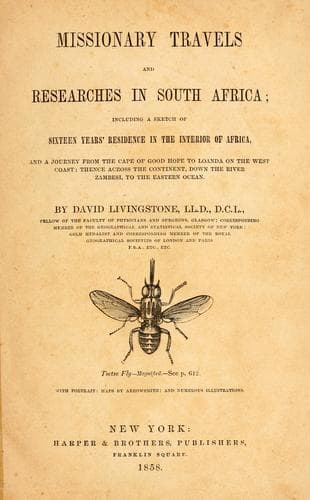
Missionary Travels and Researches in South AfricaLivingstone, David
Religion
Missionary Travels and Researches in South Africa
Livingstone, David
Missions -- South Africa; South Africa -- Description and travel
Each house of these hamlets has a palisade of thick stakes around it,
and the door is made to resemble the rest of the stockade; the door is
never seen open; when the owner wishes to enter, he removes a stake or
two, squeezes his body in, then plants them again in their places, so
that an enemy coming in the night would find it difficult to discover
the entrance. These palisades seem to indicate a sense of insecurity
in regard to their fellow-men, for there are no wild beasts to disturb
them; the bows and arrows have been nearly as efficacious in clearing
the country here as guns have in the country farther south. This was a
disappointment to us, for we expected a continuance of the abundance of
game in the north which we found when we first came up to the confluence
of the Leeba and Leeambye.
A species of the silver-tree of the Cape ('Leucodendron argenteum') is
found in abundance in the parts through which we have traveled since
leaving Samoana's. As it grows at a height of between two and three
thousand feet above the level of the sea, on the Cape Table Mountain,
and again on the northern slope of the Cashan Mountains, and here at
considerably greater heights (four thousand feet), the difference of
climate prevents the botanical range being considered as affording a
good approximation to the altitude. The rapid flow of the Leeambye,
which once seemed to me evidence of much elevation of the country
from which it comes, I now found, by the boiling point of water, was
fallacious.*
* On examining this subject when I returned to Linyanti, I
found that, according to Dr. Arnott, a declivity of three
inches per mile gives a velocity in a smooth, straight channel
of three miles an hour. The general velocity of the Zambesi is
three miles and three quarters per hour, though in the rocky
parts it is sometimes as much as four and a half. If,
however, we make allowances for roughness of bottom, bendings
of channel, and sudden descents at cataracts, and say the
declivity is even seven inches per mile, those 800 miles
between the east coast and the great falls would require less
than 500 feet to give the observed velocity, and the
additional distance to this point would require but 150 feet
of altitude more. If my observation of this altitude may be
depended on, we have a steeper declivity for the Zambesi than
for some other great rivers. The Ganges, for instance, is
said to be at 1800 miles from its mouth only 800 feet above
the level of the sea, and water requires a month to come that
distance. But there are so many modifying circumstances, it is
difficult to draw any reliable conclusion from the currents.
The Chobe is sometimes heard of as flooded, about 40 miles
above Linyanti, a fortnight before the inundation reaches that
point, but it is very tortuous. The great river Magdalena
falls only 500 feet in a thousand miles; other rivers much
more.
Public-domain text, read in full here on John Shaqi.
Reviews
Reviews
No reviews yet
Be the first to share your thoughts on this work.
Elsewhere in the archive
Join the Discussion
Join the discussion
Sign in to leave a comment or review.
Sign InorCreate an account