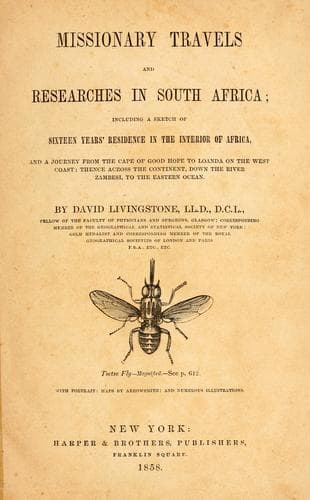
Missionary Travels and Researches in South AfricaLivingstone, David
Religion
Missionary Travels and Researches in South Africa
Livingstone, David
Missions -- South Africa; South Africa -- Description and travel
During the night we were all awakened by a terrific shriek from one of
Manenko's ladies. She piped out so loud and long that we all imagined
she had been seized by a lion, and my men snatched up their arms, which
they always place so as to be ready at a moment's notice, and ran to
the rescue; but we found the alarm had been caused by one of the oxen
thrusting his head into her hut and smelling her: she had put her hand
on his cold, wet nose, and thought it was all over with her.
On Sunday afternoon messengers arrived from Shinte, expressing his
approbation of the objects we had in view in our journey through the
country, and that he was glad of the prospect of a way being opened by
which white men might visit him, and allow him to purchase ornaments at
pleasure. Manenko now threatened in sport to go on, and I soon afterward
perceived that what now seemed to me the dilly-dallying way of this lady
was the proper mode of making acquaintance with the Balonda; and much of
the favor with which I was received in different places was owing to
my sending forward messengers to state the object of our coming before
entering each town and village. When we came in sight of a village we
sat down under the shade of a tree and sent forward a man to give notice
who we were and what were our objects. The head man of the village then
sent out his principal men, as Shinte now did, to bid us welcome and
show us a tree under which we might sleep. Before I had profited by the
rather tedious teaching of Manenko, I sometimes entered a village and
created unintentional alarm. The villagers would continue to look upon
us with suspicion as long as we remained. Shinte sent us two large
baskets of manioc and six dried fishes. His men had the skin of a
monkey, called in their tongue "poluma" ('Colobus guereza'), of a jet
black color, except the long mane, which is pure white: it is said to be
found in the north, in the country of Matiamvo, the paramount chief
of all the Balonda. We learned from them that they are in the habit of
praying to their idols when unsuccessful in killing game or in any other
enterprise. They behaved with reverence at our religious services. This
will appear important if the reader remembers the almost total want of
prayer and reverence we encountered in the south.
Public-domain text, read in full here on John Shaqi.
Reviews
Reviews
No reviews yet
Be the first to share your thoughts on this work.
Elsewhere in the archive
Join the Discussion
Join the discussion
Sign in to leave a comment or review.
Sign InorCreate an account