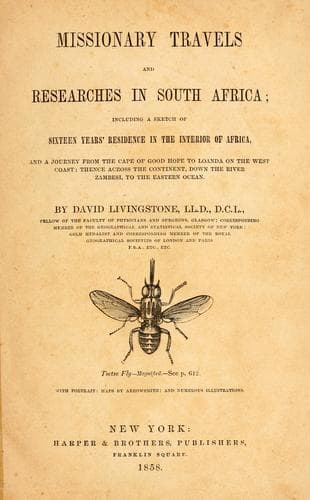
Missionary Travels and Researches in South AfricaLivingstone, David
Religion
Missionary Travels and Researches in South Africa
Livingstone, David
Missions -- South Africa; South Africa -- Description and travel
16TH. After a short march we came to a most lovely valley about a mile
and a half wide, and stretching away eastward up to a low prolongation
of Monakadzi. A small stream meanders down the centre of this pleasant
green glen; and on a little rill, which flows into it from the western
side, stands the town of Kabompo, or, as he likes best to be called,
Shinte. (Lat. 12d 37' 35" S., long. 22d 47' E.) When Manenko thought the
sun was high enough for us to make a lucky entrance, we found the town
embowered in banana and other tropical trees having great expansion of
leaf; the streets are straight, and present a complete contrast to those
of the Bechuanas, which are all very tortuous. Here, too, we first saw
native huts with square walls and round roofs. The fences or walls of
the courts which surround the huts are wonderfully straight, and made
of upright poles a few inches apart, with strong grass or leafy bushes
neatly woven between. In the courts were small plantations of tobacco,
and a little solanaceous plant which the Balonda use as a relish; also
sugar-cane and bananas. Many of the poles have grown again, and trees of
the 'Ficus Indica' family have been planted around, in order to give to
the inhabitants a grateful shade: they regard this tree with some sort
of veneration as a medicine or charm. Goats were browsing about, and,
when we made our appearance, a crowd of negroes, all fully armed, ran
toward us as if they would eat us up; some had guns, but the manner in
which they were held showed that the owners were more accustomed to bows
and arrows than to white men's weapons. After surrounding and staring at
us for an hour, they began to disperse.
The two native Portuguese traders of whom we had heard had erected a
little encampment opposite the place where ours was about to be made.
One of them, whose spine had been injured in youth--a rare sight in this
country--came and visited us. I returned the visit next morning. His
tall companion had that sickly yellow hue which made him look fairer
than myself, but his head was covered with a crop of unmistakable wool.
They had a gang of young female slaves in a chain, hoeing the ground
in front of their encampment to clear it of weeds and grass; these were
purchased recently in Lobale, whence the traders had now come. There
were many Mambari with them, and the establishment was conducted
with that military order which pervades all the arrangements of the
Portuguese colonists. A drum was beaten and trumpet sounded at certain
hours, quite in military fashion. It was the first time most of my men
had seen slaves in chains. "They are not men," they exclaimed (meaning
they are beasts), "who treat their children so."
Public-domain text, read in full here on John Shaqi.
Reviews
Reviews
No reviews yet
Be the first to share your thoughts on this work.
Elsewhere in the archive
Join the Discussion
Join the discussion
Sign in to leave a comment or review.
Sign InorCreate an account