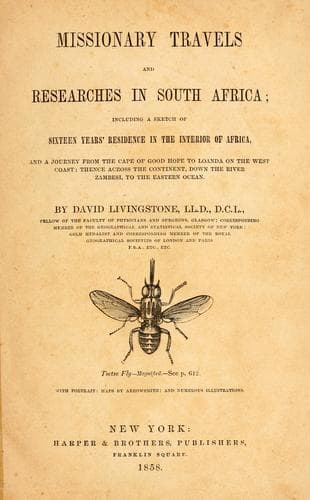
Missionary Travels and Researches in South AfricaLivingstone, David
Religion
Missionary Travels and Researches in South Africa
Livingstone, David
Missions -- South Africa; South Africa -- Description and travel
When released from our island by the rain ceasing, we marched on till
we came to a ridge of dry inhabited land in the N.W. The inhabitants,
according to custom, lent us the roofs of some huts to save the men the
trouble of booth-making. I suspect that the story in Park's "Travels",
of the men lifting up the hut to place it on the lion, referred to the
roof only. We leave them for the villagers to replace at their leisure.
No payment is expected for the use of them. By night it rained so
copiously that all our beds were flooded from below; and from this time
forth we always made a furrow round each booth, and used the earth to
raise our sleeping-places. My men turned out to work in the wet most
willingly; indeed, they always did. I could not but contrast their
conduct with that of Intemese. He was thoroughly imbued with the slave
spirit, and lied on all occasions without compunction. Untruthfulness is
a sort of refuge for the weak and oppressed. We expected to move on the
4th, but he declared that we were so near Katema's, if we did not send
forward to apprise that chief of our approach, he would certainly impose
a fine. It rained the whole day, so we were reconciled to the delay; but
on Sunday, the 5th, he let us know that we were still two days distant
from Katema. We unfortunately could not manage without him, for the
country was so deluged, we should have been brought to a halt before
we went many miles by some deep valley, every one of which was full of
water. Intemese continued to plait his basket with all his might, and
would not come to our religious service. He seemed to be afraid of our
incantations, but was always merry and jocular.
6TH. Soon after starting we crossed a branch of the Lokalueje by means
of a canoe, and in the afternoon passed over the main stream by a like
conveyance. The former, as is the case with all branches of rivers
in this country, is called nyuana Kalueje (child of the Kalueje).
Hippopotami exist in the Lokalueje, so it may be inferred to be
perennial, as the inhabitants asserted. We can not judge of the size
of the stream from what we now saw. It had about forty yards of deep,
fast-flowing water, but probably not more than half that amount in the
dry season. Besides these, we crossed numerous feeders in our N.N.W.
course, and, there being no canoes, got frequently wet in the course of
the day. The oxen in some places had their heads only above water, and
the stream, flowing over their backs, wetted our blankets, which we used
as saddles. The arm-pit was the only safe spot for carrying the watch,
for there it was preserved from rains above and waters below. The men on
foot crossed these gullies holding up their burdens at arms' length.
Public-domain text, read in full here on John Shaqi.
Reviews
Reviews
No reviews yet
Be the first to share your thoughts on this work.
Elsewhere in the archive
Join the Discussion
Join the discussion
Sign in to leave a comment or review.
Sign InorCreate an account