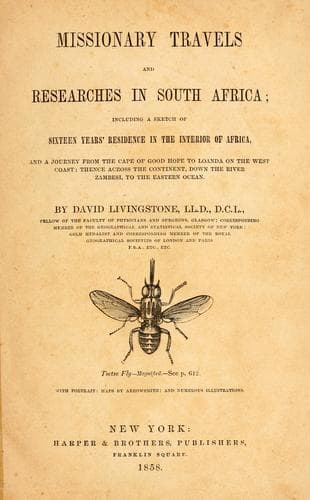
Missionary Travels and Researches in South AfricaLivingstone, David
Religion
Missionary Travels and Researches in South Africa
Livingstone, David
Missions -- South Africa; South Africa -- Description and travel
other, it exerts a good influence on their chiefs to hear what other
tribes think of their deeds. The Makololo have such a bad name, on
account of their perpetual forays, that they have not been known in
Londa except as ruthless destroyers. The people in Matiamvo's country
submit to much wrong from their chiefs, and no voice can be raised
against cruelty, because they are afraid to flee elsewhere.
We left Quendende's village in company with Quendende himself, and the
principal man of the embassadors of Matiamvo, and after two or three
miles' march to the N.W., came to the ford of the Lotembwa, which flows
southward. A canoe was waiting to ferry us over, but it was very tedious
work; for, though the river itself was only eighty yards wide, the whole
valley was flooded, and we were obliged to paddle more than half a mile
to get free of the water. A fire was lit to warm old Quendende, and
enable him to dry his tobacco-leaves. The leaves are taken from the
plant, and spread close to the fire until they are quite dry and crisp;
they are then put into a snuff-box, which, with a little pestle, serves
the purpose of a mill to grind them into powder; it is then used
as snuff. As we sat by the fire, the embassadors communicated their
thoughts freely respecting the customs of their race. When a chief dies,
a number of servants are slaughtered with him to form his company in the
other world. The Barotse followed the same custom, and this and other
usages show them to be genuine negroes, though neither they nor the
Balonda resemble closely the typical form of that people. Quendende said
if he were present on these occasions he would hide his people, so that
they might not be slaughtered. As we go north, the people become more
bloodily superstitious.
We were assured that if the late Matiamvo took a fancy to any thing,
such, for instance, as my watch-chain, which was of silver wire, and was
a great curiosity, as they had never seen metal plaited before, he would
order a whole village to be brought up to buy it from a stranger. When
a slave-trader visited him, he took possession of all his goods; then,
after ten days or a fortnight, he would send out a party of men to
pounce upon some considerable village, and, having killed the head
man, would pay for all the goods by selling the inhabitants. This has
frequently been the case, and nearly all the visitants he ever had were
men of color. On asking if Matiamvo did not know he was a man, and
would be judged, in company with those he destroyed, by a Lord who is no
respector of persons? the embassador replied, "We do not go up to God,
as you do; we are put into the ground." I could not ascertain that even
those who have such a distinct perception of the continued existence of
departed spirits had any notion of heaven; they appear to imagine the
souls to be always near the place of sepulture.
Public-domain text, read in full here on John Shaqi.
Reviews
Reviews
No reviews yet
Be the first to share your thoughts on this work.
Elsewhere in the archive
Join the Discussion
Join the discussion
Sign in to leave a comment or review.
Sign InorCreate an account